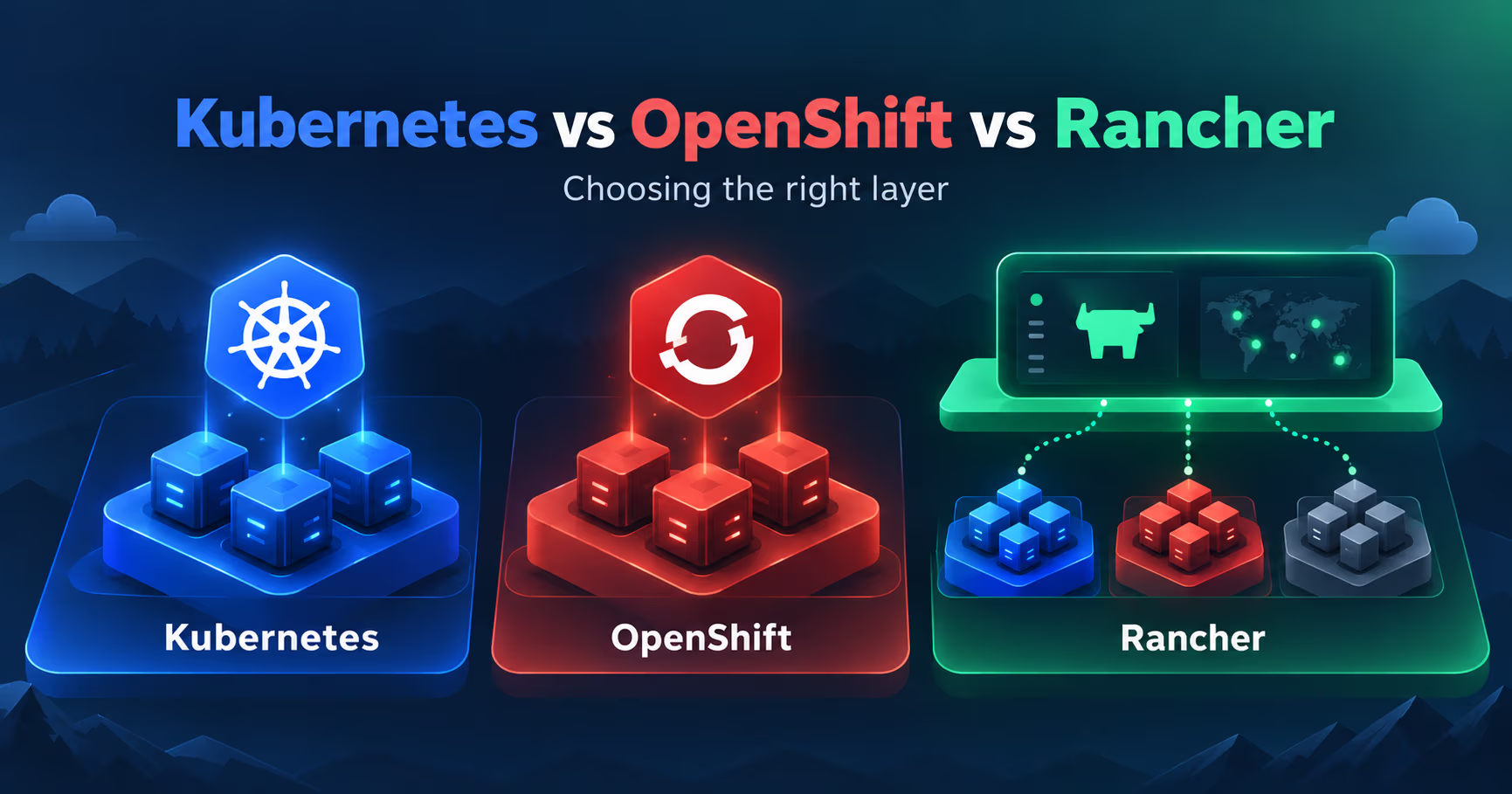
Stack Kubernetes, OpenShift, and Rancher next to each other and most comparisons start in the wrong place: they treat the three as brands of the same product.
The honest framing is that these are three different layers that happen to share a bucket of vocabulary. Vanilla Kubernetes is the upstream platform. OpenShift is Red Hat's distribution, which wraps that platform in a product with support. Rancher is SUSE's management plane, which sits on top of clusters no matter which Kubernetes built them.
The distinction is not pedantry. It decides what you install, what you pay for, whose upgrade cadence you inherit, and who the phone rings for at 2am. This post walks each of the three on its own terms, lines them up in one table, and then gives the decision rule I would actually use for a small, self-hosted fleet, because that is the ground this blog mostly stands on.
The short version
- Vanilla Kubernetes is the upstream platform. Open source under the CNCF, built from kube-apiserver, etcd, the scheduler, and the controller manager. It ships orchestration. It does not ship a management UI, a multi-cluster console, a registry, or day-2 tooling, and that is on purpose.
- OpenShift is Kubernetes wrapped in Red Hat. Upstream Kubernetes under the hood, plus Routes, SCCs, OperatorHub, an integrated registry and web console, and operator-driven upgrades. You pay a subscription and you get a supported product.
- Rancher is a management layer, not a distribution. Rancher Manager provisions and manages whole fleets, from RKE2 and K3s to imported EKS, AKS, and GKE clusters. Apache 2.0 and free, with Rancher Prime as the commercial tier.
- They are not substitutes. You cannot replace Kubernetes with Rancher, because Rancher needs a cluster to land on. You cannot sprinkle OpenShift onto a vanilla cluster, because it is a build, not a plugin. The real question is which layer you are missing.
- The decision rule: one cluster on a small budget, run vanilla or K3s. A fleet, put a management plane on top. A supported, opinionated product, OpenShift. And for most self-hosters the honest answer is still Compose, as this blog keeps saying.
What vanilla Kubernetes actually is
Kubernetes began at Google as a container orchestration system for running workloads at scale, went public in 2014 under the Apache 2.0 license, and landed in the Cloud Native Computing Foundation, where it still lives. The name is Greek for helmsman, which is why the project's logo carries a wheel. The k8s abbreviation is the letter k, the letter s, and eight characters in between.
What you actually get when you install it is a control plane and workers. The control plane is kube-apiserver (the only component you talk to), etcd (the source of truth), the scheduler, and the controller manager. Workers run kubelet, a container runtime, and kube-proxy or a CNI-driven replacement. Everything else in the ecosystem, ingress controllers, DNS, monitoring, storage drivers, GitOps, is an additive choice you make.
The word sysadmins hear constantly is upstream. It means this is the plain project as the community releases it: no vendor opinion baked in, no console, no license key, and also no one to call. Releases come roughly three times a year, and every upgrade is an exercise: read the changelog, run whatever you bootstrapped with, drain nodes, hold your breath about apiVersion changes. That friction is the engine driving people toward the other two names in this post.
What OpenShift actually is
OpenShift is Red Hat's enterprise distribution of Kubernetes, and the operative word is enterprise. Red Hat takes upstream Kubernetes, builds a tested release around it, adds product surfaces on top, and sells it under a subscription, which buys you the platform plus a support chain. The name dates to 2011 as a PaaS that predates Kubernetes; it was rebuilt on Kubernetes in 2015 with version 3. That still makes it one of the oldest names in the space, and it has collected a lot of baggage, and a lot of maturity, along the way.
The product layers over upstream are the parts that matter operationally. Routes are OpenShift's older, richer alternative to Ingress: they predate it, they handle hostname and TLS for you, and the platform also accepts standard Ingress objects, converting them to Routes behind the scenes. SCCs (SecurityContextConstraints) govern what a pod may do at runtime, such as running as root, using host networking or host paths, and which SELinux context and UIDs it runs with. They are stricter by default than upstream's Pod Security Admission; who can do what against the API is still standard Kubernetes RBAC. OperatorHub, backed by the Operator Lifecycle Manager, is the catalog for optional add-on operators, not the platform's own install mechanism; the core platform is kept current by the Cluster Version Operator and a set of built-in cluster operators. The Operator pattern itself came from CoreOS in 2016, a company Red Hat bought in 2018. There is an integrated registry (on some platforms, notably bare metal, it stays disabled until you configure storage for it), a web console, built-in Prometheus-based monitoring, and Loki-based logging available as an optional add-on operator.
Nodes run RHCOS (Red Hat Enterprise Linux CoreOS), an immutable, rpm-ostree style system image. You do not SSH into nodes to edit config files; you apply MachineConfigs and let the platform roll the change out. Upgrades are operator-driven and cluster-wide, which is the real selling point for a team that has been burned by manual kubeadm upgrades.
The honest cost: it is heavy, it is opinionated, and it is licensed. The platform ships its own monitoring, registry, and operator machinery before you have scheduled a single workload, so idle footprint and skill requirements are real. The community branch, OKD, is community-supported with no Red Hat support behind it, the usual caveat when you are evaluating without buying. It has been reworked onto CentOS Stream CoreOS, so it no longer trails the product the way it once did, but nobody is contractually on the hook for it. If your organization already lives in the Red Hat world, this is the natural home. If you are a two-person homelab, it is usually not.
What Rancher actually is
Rancher is the confusing one, because the name covers two things. There is Rancher Manager, the multi-cluster management platform, and there are the distributions it manages, RKE2 and K3s, which SUSE ships. K3s itself has been a CNCF project since it was donated in 2020, and SUSE maintains it today. The core promise is one control plane over every cluster you own, on-prem, cloud, or edge.
Rancher Manager is a UI and API that provisions new clusters and imports existing ones. It spins up RKE2 and K3s clusters, and it imports EKS, AKS, GKE, or hand-rolled clusters into the same console, giving you centralized authentication, RBAC, project isolation, and an app catalog. Around it sits Fleet, a GitOps engine for pushing manifests to fleets of clusters, plus monitoring and alerting integrations. The license is Apache 2.0 and the project is genuinely free; Rancher Prime is the commercial tier with support and SLAs.
The distributions fill two different jobs. RKE2 is the hardened, security-focused one: close to upstream, containerd, embedded etcd on the control plane, and FIPS-ready settings, which is why regulated environments reach for it. K3s is the featherweight: a single small binary, SQLite by default with optional etcd, built for edge gateways, Raspberry Pi stacks, and single-node homelabs. Same management plane, very different footprints.
| Feature | RKE2 | K3s |
|---|---|---|
| Position | Hardened, production-grade distribution | Lightweight distribution for small and edge workloads |
| Control plane storage | Embedded etcd | SQLite by default, optional etcd |
| Runtime | containerd with strong security defaults | containerd in a single binary |
| Compliance | FIPS-ready hardening | Trades some hardening for size |
| Who wants it | Regulated and enterprise environments | Homelabs, edge gateways, tiny boxes |
| Best for | Multi-node production clusters | Quick starts and single-node fleets |
Position
- RKE2
- Hardened, production-grade distribution
- K3s
- Lightweight distribution for small and edge workloads
Control plane storage
- RKE2
- Embedded etcd
- K3s
- SQLite by default, optional etcd
Runtime
- RKE2
- containerd with strong security defaults
- K3s
- containerd in a single binary
Compliance
- RKE2
- FIPS-ready hardening
- K3s
- Trades some hardening for size
Who wants it
- RKE2
- Regulated and enterprise environments
- K3s
- Homelabs, edge gateways, tiny boxes
Best for
- RKE2
- Multi-node production clusters
- K3s
- Quick starts and single-node fleets
Why they are not the same kind of thing
The cleanest way to see it: Kubernetes is the raw material, OpenShift is a finished product made from it, and Rancher is the crane that moves whole warehouses of it. Strip the branding and the question is not which one wins. It is which layer your situation is missing.
That also explains the common failure modes. People try to replace Kubernetes with Rancher and discover Rancher itself needs a Kubernetes cluster to run on. People try OpenShift expecting vanilla and get hit by a machine configuration they cannot apt-get their way around. The tools are not competitors. They are neighbors on different floors of the same building.
Kubernetes vs OpenShift vs Rancher at a glance
Dimension | Kubernetes (upstream) | OpenShift (Red Hat) | Rancher (SUSE) |
|---|---|---|---|
What it is | Upstream orchestration platform | Enterprise distribution built on Kubernetes | Multi-cluster management plane; also ships RKE2 and K3s |
License | Apache 2.0, free | Commercial subscription | Apache 2.0, free; Prime for support |
Install path | kubeadm, kubespray, kOps, or a cloud service | Installer provisions RHCOS nodes | Runs on a bootstrap cluster, manages the rest |
Multi-cluster | Not included | Single cluster per install; multi-cluster via ACM in OpenShift Platform Plus | The whole point |
Day-2 upgrades | Manual and release-driven | Operator-driven platform upgrades | Fleet pushes and cluster provisioning |
Node OS | Whatever you choose | RHCOS, immutable | Whatever the underlying cluster runs |
Best for | Teams that want full control | Enterprises that want support and opinion | Anyone managing many clusters |
Where each one bites
- Vanilla: the assembly is the product. No vendor to blame, no console to open, no default for half the stack. Every choice (CNI, ingress, storage, GitOps) is yours, forever.
- OpenShift: the opinion is the point, and so is the bill. Idle footprint is heavy, the node OS is immutable, and the subscription matters. OKD is there for evaluation but it is not a supported production path.
- Rancher: it adds a control plane, not removes one. The manager cluster and its agents are now a failure domain you own. Pick the underlying distribution carefully, because Rancher does not fix a bad distro, it centralizes it.
$ kubectl version
Client Version: v1.37.0
Server Version: v1.37.0

# that tells you the Kubernetes version, not who built it
# OpenShift ships its own client and extra APIs
$ oc version
Client Version: 4.22.0
Server Version: 4.22.0

# on a Rancher-managed node, the agent and fleet pods give it away
$ kubectl get pods -A | grep -E 'cattle|fleet'
Versions checked
- Kubernetes
1.37.0 (Aug 2026) - OpenShift
4.22 line (GA June 2026) - Rancher Manager
2.15.1 (Aug 2026) - RKE2
v1.37.0+rke2r1 - K3s
v1.37.0+k3s1
Checked 2026-09-22 against the official release pages linked below. Release lines move fast; reconfirm before you pin anything in your own stack.
Which should you pick?
- One cluster, small budget, hands-on vibe: vanilla Kubernetes or K3s. You keep control, you keep the assembly work, and you keep the whole thing free.
- A fleet across clouds and edge: Rancher. Import what you already have, provision the next ones, centralize auth and GitOps. This is the layer that earns its keep.
- A regulated environment: RKE2 for the hardening and FIPS readiness, or OpenShift if you want the full product wrapped around that hardening.
- An organization that wants a supported product: OpenShift. Pay the subscription, get the support chain, console, registry, monitoring, and operator-driven upgrades out of the box.
- Most self-hosted apps: stay on Compose. The Compose vs Kubernetes post makes the argument in full, and it is still true here: Kubernetes only earns its weight when you have real scale or fleet diversity.
The answer this blog keeps returning to is that the platform is the last layer you should add, not the first. If you already run ArgoCD for GitOps, the ArgoCD vs Flux comparison is your turf, and if you bootstrapped a cluster from scratch, the OpenTofu with ArgoCD walkthrough shows what vanilla assembly looks like. The decision rule that survives contact with real servers: pick Kubernetes for control, OpenShift for support, Rancher for fleet management, and remember that for a small self-hosted stack the honest answer is usually none of them, at least until you outgrow the box.
Official sources
- Kubernetes: https://kubernetes.io and https://kubernetes.io/releases/
- OpenShift: https://www.redhat.com/en/technologies/cloud-computing/openshift and https://docs.openshift.com
- Rancher: https://www.rancher.com
- RKE2 docs: https://docs.rke2.io and K3s docs: https://docs.k3s.io
- Our Compose vs Kubernetes post: https://systhoughts.com/posts/docker-compose-vs-kubernetes-self-hosted-apps
- Our GitOps comparison: https://systhoughts.com/posts/argocd-vs-flux-gitops-comparison
- Our Kubernetes bootstrap walkthrough: https://systhoughts.com/posts/opentofu-bootstrap-kubernetes-with-argocd
Are you running one of these three, or did you decide the honest answer was Compose? Where did the layer you chose bite you first, at install time or at the first upgrade? Drop it in the comments.
Until next time, keep your systems thoughtful.
No comments yet