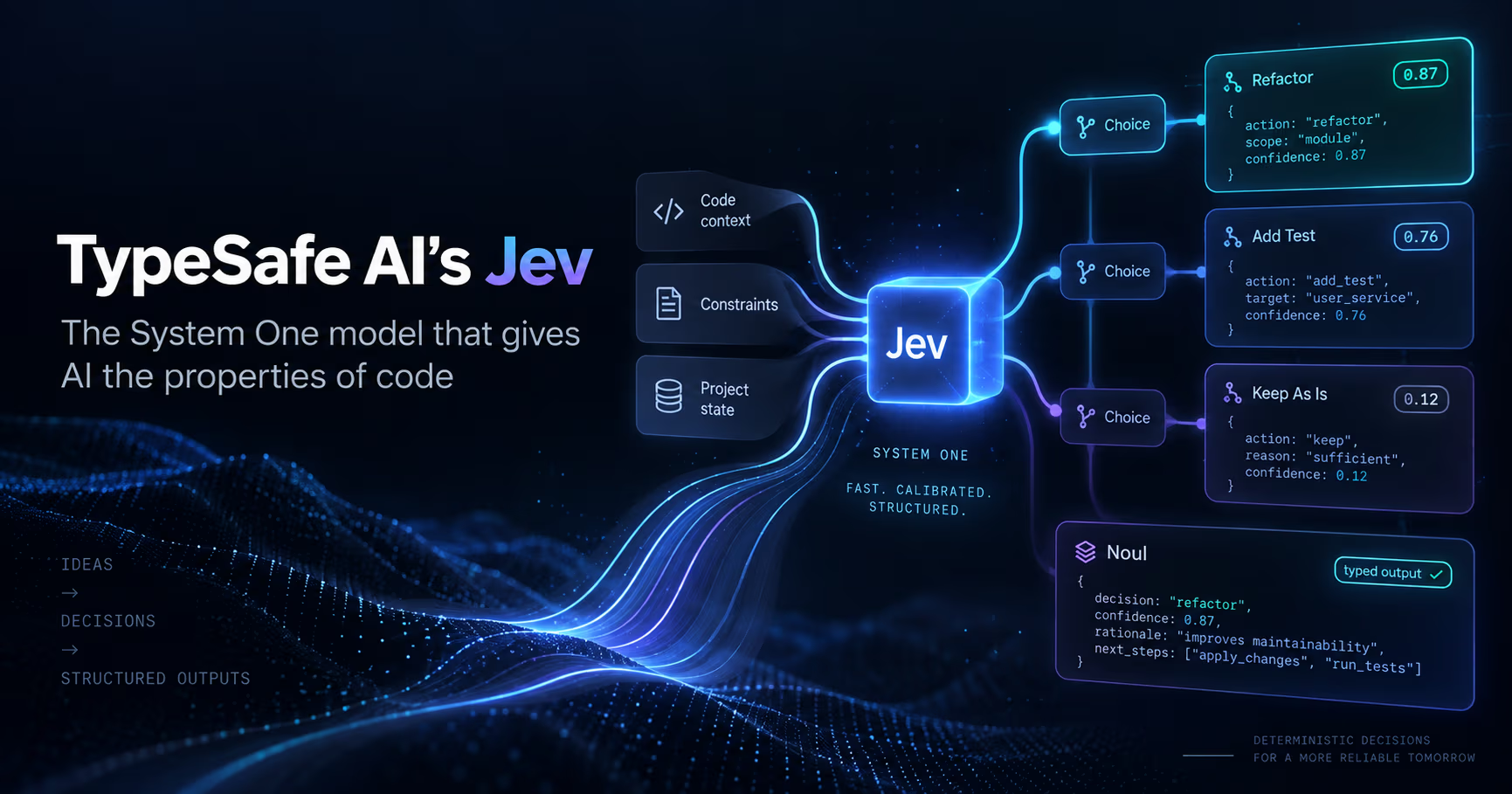
On September 15, 2026, TypeSafe AI came out of two years in stealth and released Jev, which it calls the first public System One model.
The question the company says it has chased for four years is simple: models have been superhuman at chat for years, so where is all the automation? TypeSafe's answer is to stop having AI write words for people and start having it make decisions for machines.
Send Jev unstructured state plus typed questions, and it returns typed answers: a choice, a score, or a yes/no probability, each with a calibrated confidence. No parsing, no validation layer, no hallucinated tool call, and a response in 70 to 500 milliseconds.
Jev cannot write a sentence. It is optimized for structured outputs and, by construction, cannot return a type error. That trade sounds like a downgrade until you try to put a chat model inside an if statement.
The short version
- Not a chat model. Jev is a System One model built for machine use: structured state in, typed probabilistic decisions out. Possible outputs and structure are defined in advance, so schema conformance is guaranteed.
- Every answer carries calibrated confidence. The three question types, Noul, Choice, and Score, return probabilities alongside the answer, so your code can act when confidence is high and escalate when it is not.
- Two orders of magnitude faster and cheaper. TypeSafe publishes 70 to 500 ms end to end and $42 per billion input tokens with output too cheap to meter, and its workflow evals claim 193.6x faster and 444.6x cheaper than frontier chat models on System One shaped tasks.
- New training recipe. RLCD (Reinforcement Learning for Calibrated Decisions) replaces RLHF and RLVR, optimizing epistemically honest probabilities over human-preferred text.
- Early access, not GA. Jev is waitlisted today, with Python and JavaScript SDKs plus an agent skill for Claude Code and Codex. Pricing and model names will move.
- Skeptics welcome. The headline numbers are vendor-run. Independent testing is already underway: one practitioner test found Jev caught 6 of 7 injected defects in a median of 0.35 seconds per passage, versus 7 of 7 for the frontier reference model at 8.83 seconds.
- Jev model
jev-latest (Jev 1.x line as of docs) - API endpoint
POST https://api.typesafe.ai/v1/systemone - Python SDK
typesafe-sdk, TypeSafeClient - JavaScript SDK
TypeSafeClient (npm) - Input pricing
$42 per billion tokens; output free - End-to-end latency
70-500ms (vendor-published)
Checked 2026-09-17 against typesafe.ai, the September 15, 2026 launch post, docs.typesafe.ai (introduction, quickstart, API reference), and the Businesswire funding release. Everything here is early access and will move, and the 193.6x / 444.6x speed and cost multiples are TypeSafe's own workflow evals, not independent measurements.
Why everybody is talking about it
The launch post, "Introducing System One Models & Jev", sat at roughly 1,847 points and 485 comments on Hacker News on September 17, 2026, measured via the HN Algolia API about 48 hours after it went up. That is front page gravity for a lab most people had never heard of. Threads followed on r/singularity and r/hackernews, X posts, YouTube deep dives with headlines like "The Model That Killed Chat GPT's Core Idea?", and a Medium essay titled "What is Jev? Why the Model That Can't Write a Sentence Is the One I'd Put in Production."
The idea is compact and contrarian enough to spread: give up string generation and gain speed, cost, and safety, and get output your code can branch on directly. Within a day, third parties were benchmarking. Two of the early independent results: a Jev versus Mistral Small and Gemini Flash-Lite comparison for local event validation, and an early open source replication attempt, Qwen-2.5-1B-RLCD, on Hugging Face. Two days in, the conversation has moved from "is this real?" to "what do I measure first?"
The reception is not uniform, and that is healthy. Half the room says this is the automation primitive we were missing; the other half says extraordinary claims require extraordinary evidence. Both are right. Treat the hype as a signal to test, not a reason to trust.
TypeSafe also emerged from stealth with $40 million in funding, reported by Businesswire alongside the launch, so this is a real lab with real backing, not a weekend project. The founder, Diogo Almeida, coauthored the InstructGPT paper at OpenAI in 2022, the work that helped pave the way for ChatGPT, which gives the contrarian thesis some provenance.
Decisions instead of strings: the actual shift
A chat model is a text generator. When you need a decision inside software, you prompt it, parse the text, validate the structure, and hope it did not go off the rails. TypeSafe's claim is that the text itself is the problem: strings are flexible and general, but every parse and validation step is where automation breaks.
System One models invert the design. State goes in, questions are defined in advance, and the model evaluates them in parallel in a single query. The output shape cannot be violated, which is why the company can claim zero hallucinated tool calls: there is no free form space to hallucinate into. Every answer ships with calibrated confidence, meaning higher confidence correlates with higher accuracy, which is exactly what an automated system needs to decide between acting and asking.
| Feature | Chat LLM | Jev (System One) |
|---|---|---|
| Output | Strings: chat, code, refusals, hallucinations | Typed values, structure defined in advance |
| Use in software | Parse, validate, hope it stayed on rails | Branch, route, score directly |
| Confidence | Prompted guess, overconfident, inconsistent | Calibrated on every answer |
| Sampling | Sequential, one token at a time | Parallel, all questions in one query |
| Type errors | Possible, including hallucinated tool calls | Impossible by construction |
| Response time1 | 3 to 329 seconds for frontier models | 70 to 500 ms |
| Input price2 | $0.20 to $10 per million tokens | $0.042 per million tokens, output free |
Output
- Chat LLM
- Strings: chat, code, refusals, hallucinations
- Jev (System One)
- Typed values, structure defined in advance
Use in software
- Chat LLM
- Parse, validate, hope it stayed on rails
- Jev (System One)
- Branch, route, score directly
Confidence
- Chat LLM
- Prompted guess, overconfident, inconsistent
- Jev (System One)
- Calibrated on every answer
Sampling
- Chat LLM
- Sequential, one token at a time
- Jev (System One)
- Parallel, all questions in one query
Type errors
- Chat LLM
- Possible, including hallucinated tool calls
- Jev (System One)
- Impossible by construction
Response time1
- Chat LLM
- 3 to 329 seconds for frontier models
- Jev (System One)
- 70 to 500 ms
Input price2
- Chat LLM
- $0.20 to $10 per million tokens
- Jev (System One)
- $0.042 per million tokens, output free
- vendor-published figures
- $42 per billion input tokens
How to use it
The API is one endpoint, POST https://api.typesafe.ai/v1/systemone, with a state and a questions map. Three question types cover most judgments:
Question type | What it asks | What it returns |
|---|---|---|
Noul | Is this statement true? | Probability between 0 and 1 that yes is the answer |
Choice | Pick one option from a defined set | The chosen option, probabilities per option, confidence |
Score | Rate the state against ordered levels | A score on the legend, probabilities per level, confidence |
All question types can be mixed in one call and are evaluated in parallel and in isolation against the same state, so adding questions barely changes response time.
$ curl -X POST https://api.typesafe.ai/v1/systemone \
  -H "Authorization: Bearer $TYPESAFE_API_KEY" \
  -H "Content-Type: application/json" \
  -d @- << 'EOF'
{
  "state": "Hi, I've been trying to connect my Stripe account for 3 days and it keeps failing. I'm losing sales. Please help ASAP.",
  "model": "jev-latest",
  "questions": {
    "urgency": {
      "type": "noul",
      "instructions": "Does this message express urgency?"
    }
  }
}
EOF

# response.answers.urgency.noul -> 0.999
The Python SDK mirrors the API. The documented quickstart example, a customer support ticket classified by department, frustration, and urgency, looks like this:
from typesafe_sdk import Choice, Noul, Score, TypeSafeClient

client = TypeSafeClient()

ticket = (
    "Hi, I've been trying to connect my Stripe account for 3 days "
    "and it keeps failing. I'm losing sales. Please help ASAP."
)

response = client.system_one(
    state=ticket,
    questions={
        "department": Choice(
            instructions="Which team should handle this",
            criteria={
                "billing": "Payment or subscription issues",
                "technical": "Bugs or integration problems",
                "sales": "Pricing or account questions",
            },
        ),
        "frustration": Score(
            instructions="How frustrated the customer appears",
            criteria=[
                "Calm, just stating facts",
                "Frustrated but civil",
                "Very angry, strong language",
            ],
        ),
        "is_urgent": Noul(
            instructions="The message conveys urgency or time-sensitivity"
        ),
    },
)

print(response.answers["department"].choice)   # billing
print(response.answers["frustration"].score)   # 1.035
print(response.answers["is_urgent"].noul)      # 0.999
The documented patterns matter more than the syntax. Confidence-gated routing uses confidence as a second axis: the answer tells you what, confidence tells you whether to act. Composite scoring breaks one complex judgment into atomic questions and lets your code weight the results. Speculative fan-out sends many questions in one call and keeps the relevant ones. Intent routing classifies each request into a deterministic handler, a specialist LLM, or a human. The surrounding code constrains the model's freedom, which is exactly how you make fuzzy decisions reliable.
New opportunities in code
Three things open up for developers, and they are all consequences of speed and structure.
First, guardrails in the hot path. TypeSafe's own framing is verify everything: score, judge, verify, guardrail, and detect jailbreaks of LLM prompts, reasoning traces, and outputs. Check citations against their source document, screen RAG passages for prompt injection before they reach the answering model, flag a risky action an agent proposes, all at a cost and latency that let you run the check on every turn instead of on a sample. Mike Taylor at Every described it as a code linter for knowledge work: run your checks after each paragraph a writing model produces, and let the writing model revise before the draft is done.
Second, real time intelligence. 70 to 500 ms is fast enough for in-request decisions. The team's Doom demo drove a reactive bot at roughly 10 queries per second for about $7 an hour, and the Wikiracing demo showed the compounding benefit of not hallucinating across high cardinality choices.
Third, smaller machines around agents. The docs cookbook covers function calling from natural language, RAG passage classification, citation double checking, and massive parallel scoring, 218 line IDs against a query in one request. If you already run agents in Docker or fight token budgets in coding workloads, this slot is the layer that decides before an LLM spends tokens, which is the same theme as our token reduction post and our Docker sandbox post for agents. One warning: for now the model reads structured text state, not images, and a single Choice question is capped at 255 options, with higher cardinality handled by a two stage scoring pass.
New opportunities in business
The business case is unit economics plus auditability. At $42 per billion input tokens with output free, a judgment costs fractions of a cent, which changes what you can afford to automate. Every's experiment is the cleanest example so far: 777 judgments across 37 documents in under 0.7 seconds for about a quarter of a cent, then 1,709 judgments across 11 experiments for under a cent total. At that price you run a model on every ticket, every invoice, every transaction, not on a sample.
The second shift is consistency and an audit trail. A chat model explains, hedges, and flatters; Jev returns a number and a confidence, reproducible enough to log, threshold, and review. Every decision is a tuple you can store: input, question, answer, probability, confidence. That is the kind of record a compliance review can actually consume. TypeSafe's operating line, as quoted by Every, is "We're building prod, not God," and the Jevons Paradox naming is deliberate: every order of magnitude drop in the cost of intelligence unlocks orders of magnitude more use cases, the way cheap steam power multiplied coal demand in the nineteenth century.
Operationally, the obvious first jobs are support severity and routing, invoice matching, fraud flags, content moderation, lead and pitch scoring, and decision routing for humans: which emails need a reply today, which decisions need a person. Every one of those is a repeated judgment that was too expensive or too inconsistent to run before. If you are building this kind of automation today, the honest architecture is the one our durable workflows post describes, with a decision layer where the model sits inside your control flow instead of around it.
The caveats, stated plainly
- Type safety is not correctness. "Cannot hallucinate" means cannot emit an invalid structure, not cannot be wrong. The docs publish jaggedness notes for jev-1.13, and the company's own FAQ says Jev can still get things wrong; that is the whole point of calibrated confidence, because you can measure how often.
- The speed and cost multiples are vendor-reported. They come from TypeSafe's own workflow evals, and the company says they are likely on the higher end of real world gains.
- Pricing sustainability is unproven. TypeSafe says it cannot yet prove the price is not subsidized, though it expects prices to fall over time.
- Calibration must be verified on your workload. RLCD targets calibration, but the only defensible move is to test on your own data and tune your thresholds.
- It is an API dependency today. There is no open weight path for Jev, and the open source replicas are days old. If the judgment sits in a latency or sovereignty critical path, that matters.
- Jev (median per passage): 4 checks x 12 passages, caught 6 of 7 defects
- Fable 5.1, high effort (median per passage): caught all 7 defects in the same test
Should you build on it yet?
- Queue for early access when you have a repeated judgment inside a workflow and latency or cost currently forces you to skip it or hand it to a human.
- Test it when you can act on calibrated probabilities and you will measure calibration on your own data before trusting it.
- Hold off if you need prose, open weights, long reasoning chains, or a fully offline stack. Jev is a decision layer, not a replacement for chat models.
- Keep the architecture honest. LLMs write and reason, Jev decides, and your code owns the thresholds, weights, and escalation paths. The model is the primitive; the workflow is the product.
Official sources
- TypeSafe AI home and waitlist: https://typesafe.ai/
- Launch post "Introducing System One Models & Jev": https://typesafe.ai/blog/introducing-system-one-models-and-jev
- Documentation and quickstart: https://docs.typesafe.ai/ and https://docs.typesafe.ai/introduction/quickstart
- Hacker News thread: https://news.ycombinator.com/item?id=49717558
- Businesswire, TypeSafe AI emerges from stealth with $40M: https://www.businesswire.com/news/home/20260915525333/en/
- Every, "Mini-Vibe Check: TypeSafe's Jev Judged Everything I've Written in 0.7 Seconds": https://every.to/also-true-for-humans/mini-vibe-check-typesafe-s-jev-judged-everything-i-ve-written-in-0-7-seconds
- Our token reduction post: https://systhoughts.com/posts/reduce-token-usage-ai-coding-agents
- Our Docker sandbox post for AI agents: https://systhoughts.com/posts/docker-sandboxes-ai-agents
- Our durable workflows post: https://systhoughts.com/posts/durable-workflows-for-architects
- Our TypeScript agent framework comparison: https://systhoughts.com/posts/mastra-vs-flue-2-0-typescript-agent-frameworks
Are you on the Jev waitlist? What judgment would you automate first, and what would convince you the calibration is real? Drop it in the comments.
Until next time, keep your systems thoughtful.
No comments yet