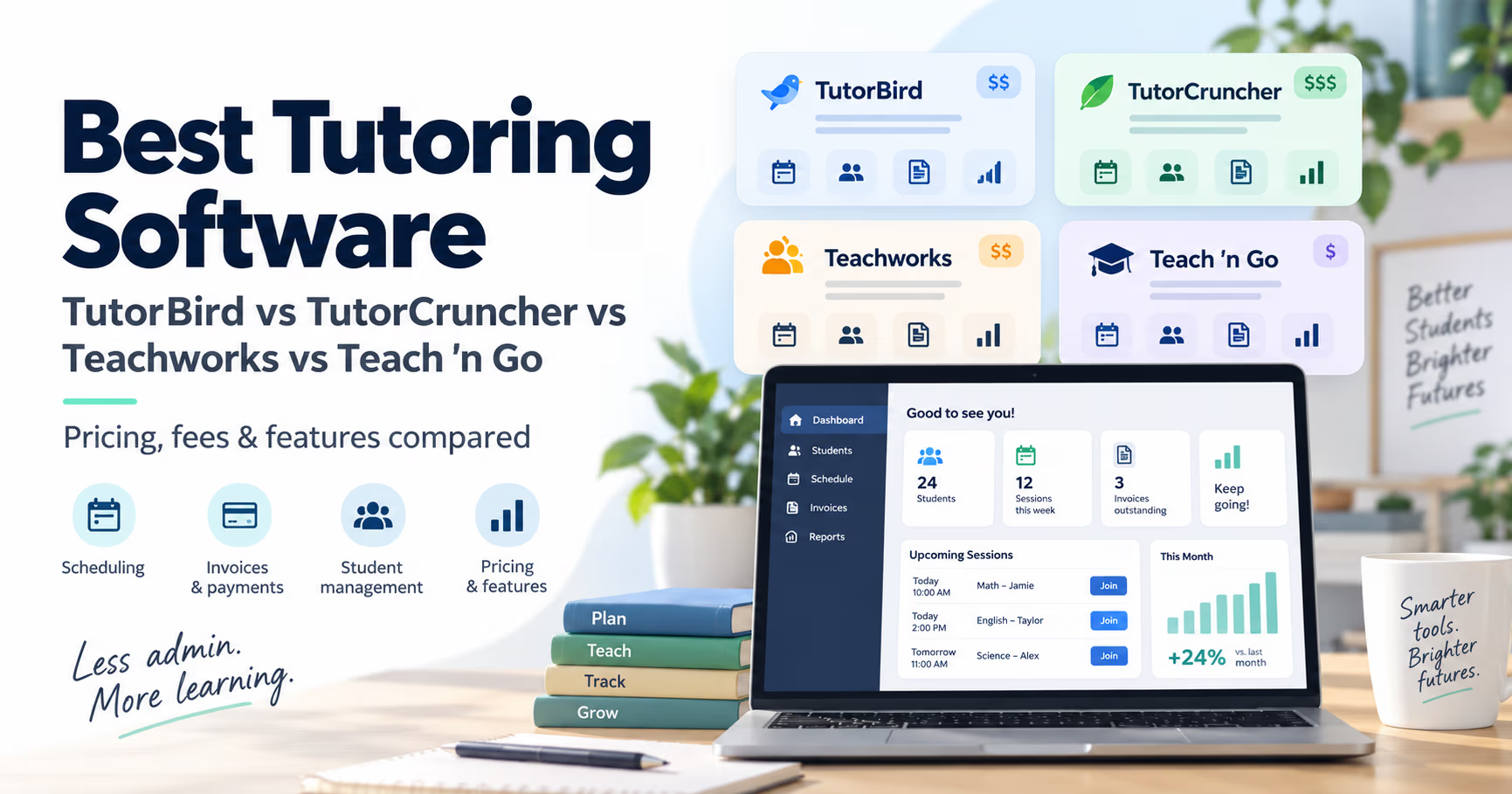
For a tutor running their own business, the decision is not which dashboard looks friendlier, it is which tool keeps students, schedules, invoices, and payments straight for one person who has no office manager, and at what real price once the per-lesson fees, card fees, and tier fine print are included. Tutoring software reviews mostly compare screenshots. The products separate on pricing models, caps, and what the export looks like when you leave.
TutorBird, TutorCruncher, Teachworks, and Teach 'n Go are the shortlist a solo tutor or small studio actually meets. Each is a real product with a real identity, and the marketing pages make all of them look equivalent. They are not.
Marketplaces such as Wyzant, Preply, and Superprof are a different animal: they take a cut of every lesson and own the client relationship, so they solve a different problem than software for a business you own. White-label builders such as Yo!Coach are developer projects, not tools you run this afternoon.
The short version
- The pricing model is the product. TutorBird sells a flat base plus per-staff seats, TutorCruncher sells tiered plans plus transaction fees, Teachworks sells usage-based per-student-lesson pricing, and Teach 'n Go sells per-student bands. The sticker price tells you almost nothing.
- TutorBird is the solo-tutor default: $16.95 per month for the first tutor, $4.95 for each additional tutor or staff member, unlimited students, a 30-day trial, and a 90-day money-back guarantee.
- TutorCruncher is the agency tool: pay-as-you-go from $30 per month, Startup at $80, Enterprise at $240, with card fees of 3.85 percent or 3.5 percent and offline payment fees up to 1 percent on top, SMS billed per message, a two-week free trial, an API the pricing page lists under Enterprise, and a $100 per month custom domain.
- Teachworks is the usage-scaled middle: Starter at $16.49 per month plus $0.32 per student lesson, Growth at $47.99 plus $0.189, Premium at $187.99 plus $0.065, with API access arriving on Growth.
- Teach 'n Go is the flat-per-student option: $79 per month (USD) for up to 100 live students, $109 for Pro, with bands up to 2,000 students and an API that is read-only on the base plan and read-write on Pro.
- Do not decide on the sticker. Decide on the tier that covers your real lesson count, the fees that sit underneath the base price, and what the export looks like when you leave.
- Every tool here can schedule a lesson and send an invoice. The differences that matter are the per-lesson math, the transaction fees, the API, and the exit.
- TutorBird
Base $16.95/mo; +$4.95 per additional tutor or staff; unlimited students; SMS included; 30-day trial; 90-day money-back - TutorCruncher (USD)
Pay-as-you-go from $30/mo; Startup $80; Enterprise $240; card fees 3.85%/3.5%; Amex/Diners/JCB/prepaid/UnionPay +2%; intl cards +1.5%; offline fees 1%/0.65%/0.5%; SMS per message; custom domain $100/mo; API & custom integrations listed under Enterprise; 2-week trial - Teachworks (USD)
Starter $16.49 + $0.32 per student lesson; Growth $47.99 + $0.189; Premium $187.99 + $0.065; API from Growth; billed after month-end on usage; 21-day trial - Teach 'n Go (USD)
Base $79/mo up to 100 live students; Pro $109; bands to 2,000; base caps: 1,000 emails/mo, 150 recipients/send, 3 admins, 1 location; AI on base: 15 questions + 30 drafts/mo; read-only API on base, read-write on Pro; 14-day trial
USD list prices collected from official vendor pricing pages, checked 2026-09-22. Teachworks also shows alternative annual-style pricing ($15/$45/$175); confirm your currency and billing term before budgeting. Teachworks publishes no lesson threshold; the 240-lesson and 1,130-lesson break-evens are computed from the USD list prices above. Treat every number as directional.
What a tutoring business actually requires
Before comparing vendors, write the requirement list, because the tool for one tutor is a different product from the tool for a ten-teacher studio.
- Scheduling and attendance. Calendar, lesson reminders, rescheduling, cancellations, make-ups, attendance records. This is the daily surface and the reason most tutors pick a tool at all.
- Invoicing and payments. Recurring invoices, package billing, online payments, late fees. This is where the fine print lives: per-lesson fees, card processing percentages, and payout delays.
- Student records. Profiles, progress notes, file sharing, homework, lesson history. The tool should make the next session obvious without hunting through email.
- Parent or student portal. A place where clients can book, pay, and see progress. This is a differentiator, not a checkbox, on the entry tiers.
- Multi-tutor support when you grow. Permissions, separate schedules, payroll calculation. Most tools charge per seat or per lesson, and the math changes the moment the second tutor appears.
- Communication. Email and SMS reminders, bulk messaging, and the deliverability behind them. TutorBird bundles SMS reminders into the subscription; TutorCruncher bills SMS per message.
- Reporting and export. Revenue summaries, tax reports, and a clean export when you switch. Data you cannot leave with is a liability.
- API and automation surface. A public API, webhooks, or dependable integrations, so scheduling moves, invoice creation, and payment reconciliation do not become a manual ritual.
Keep that list next to you while reading. Every tool here can book a lesson. The list is what separates them.
The shortlist
TutorBird
TutorBird is the flat-rate specialist built for private tutors and small studios, and it is the most predictable bill in the group: $16.95 per month for the owner, $4.95 per month for each additional tutor or staff member, and that is the entire pricing story.
No per-student fees, no per-lesson fees, no transaction percentages published on top of Stripe and PayPal. The base price includes unlimited students and unlimited file storage, scheduling, attendance, invoicing, expense tracking, learning management (files, homework, progress), a student portal, a drag-and-drop website builder with free hosting, two-way calendar sync, and SMS reminders included in the subscription. There is a 30-day free trial with no credit card required and a 90-day money-back guarantee, which is the most generous refund policy in this comparison.
The honest catch is scale and surface: it is a management tool, not a payroll engine. Multi-tutor support covers access, schedules, and payroll tracking, but automated payouts and split payments are not its lane the way they are on TutorCruncher. Integrations run through Zapier plus native Stripe, PayPal, Zoom, Google Calendar, Outlook, QuickBooks, and Lessonspace, and there is no public API in the same sense TutorCruncher documents.
- The strength: one flat price, unlimited everything at the entry tier, the friendliest trial and refund terms, and a free hosted website builder: build the site in TutorBird and they host it for you at no charge.
- The catch: the transaction layer is whatever Stripe or PayPal charges you, payroll automation is shallow, and the integration surface is Zapier-shaped rather than API-native.
- Best for: a solo tutor who wants one predictable bill and no per-lesson surprises, or a small studio that has not outgrown seat pricing.
TutorCruncher
TutorCruncher is the agency-grade option and the one built for tutoring companies rather than individual tutors: multiple tutors, branches, split payments, automated payouts, and a documented API for custom integrations. Pricing runs three tiers, pay-as-you-go from $30 per month, Startup at $80, Enterprise at $240, and the honest fine print is that the base price is not the full price. Card payments cost 3.85 percent on pay-as-you-go and 3.5 percent on Startup (Enterprise gets bespoke high-volume rates), international cards add 1.5 percent, and American Express, Diners Club, JCB, prepaid cards, and UnionPay add 2 percent. Offline payments that are not processed through the platform cost 1 percent on pay-as-you-go and 0.65 percent on Startup. Automated payouts add 0.2 percent of each invoice, extra branches are $50 per month each, and a custom domain for a white-labeled client experience is $100 per month. The built-in video conferencing includes 20,000 minutes at no additional cost before per-minute charges apply ($0.01 per participant per minute after that). There is a two-week free trial with free cancellation.
The honest strength is depth: split payments between tutors and the studio, automated payroll, and client pipelines are on every tier, while custom HTML email templates and user and report exports arrive on Startup and Enterprise, not pay-as-you-go. The API documentation is public, but the pricing page lists API & custom integrations under Enterprise only, so treat the API as an Enterprise feature when you budget. SMS, which TutorBird includes in the subscription, is billed per message here. The trade is price complexity, you cannot know your bill without modeling your payment mix, and the entry tier is pricier than TutorBird once you do.
- The strength: the only tool here with split payments and automated payouts, plus branch support and a public API listed under Enterprise on the pricing page.
- The catch: transaction fees stack on top of the base price, SMS is billed per message, user exports and custom email templates start at Startup rather than pay-as-you-go, and extras such as branches and custom domains are per-item charges.
- Best for: a tutoring business with multiple tutors and split revenue, or a studio that wants automated payroll and a real API.
Teachworks
Teachworks sits in the middle and prices by usage, which makes it honest about cost and slightly unpredictable at the same time: Starter at $16.49 per month plus $0.32 per student lesson, Growth at $47.99 plus $0.189 per student lesson, Premium at $187.99 plus $0.065, with a 21-day free trial and no contracts. Student lessons are counted per student, so a lesson with two students counts as two student lessons, and cancelled lessons are excluded.
The Growth and Premium tiers include API access (the API is not on Starter), and Premium includes the first five branch accounts plus $35 per month per additional branch. Every plan claims unlimited students, teachers, and user accounts, which is unusual for the entry tier. Billing also trails the month: Teachworks charges your card after the end of each month based on your usage during that month, pro-rated if you join partway through, so the bill always lags the lessons it covers.
The varying bill is the feature and the catch. On Starter, 200 student lessons a month works out to about $80, and 500 lessons to about $176; on Growth the same volumes run about $86 and $142, which is why the usage math matters. Teachworks publishes no lesson threshold for when a higher tier becomes cheaper, but the list prices carry their own break-even: Growth undercuts Starter at roughly 240 student lessons a month, and Premium undercuts Growth at roughly 1,130. Below 240 lessons, Starter is still the cheaper plan, as the 200-lesson example shows. That is the pricing-model reality this review keeps repeating: the sticker is a base, not a bill.
- The strength: unlimited students, teachers, and users even on Starter, usage-based pricing that scales down in quiet months, and API access from Growth.
- The catch: the per-lesson fee makes the monthly bill swing with volume, API is gated out of the entry tier, and you must re-price tiers as volume grows.
- Best for: a tutor or small studio whose lesson count fluctuates and who wants to pay for actual usage rather than a flat seat model.
Teach 'n Go
Teach 'n Go prices by live-student bands and bundles the complete core platform into every plan, which is the closest thing this market has to predictable flat pricing at studio scale. The USD list starts at $79 per month for up to 100 live students on the base plan and $109 on Pro, with bands at 200 ($99 and $139), 300 ($129 and $179), 500 ($189 and $259), 700 ($229 and $309), 1,000 ($299 and $399), 1,500 ($379 and $499), and 2,000 ($459 and $599); paying annually gets two months free.
Every plan includes unlimited teachers and classes, scheduling, attendance, invoicing, online booking, student and parent portals, and group messaging, and manual CSV export is included on every plan. The base plan does cap the messaging layer, though: 1,000 emails composed per month, 150 recipients per send, 3 admin users, and a single location. The API is read-only at 1,000 requests per day on the base plan and read-write at 10,000 per day on Pro. AI is not Pro-only: the base plan already includes 15 Ask AI questions and 30 AI drafts a month, and Pro removes those caps while adding multiple branches, your own URL and branding, and priority support. There is a 14-day free trial and a 30-day money-back guarantee.
The honest catch for a solo tutor is the band floor: if you have 25 students, you are still on the 100-student band at $79, which is a lot more than TutorBird per month, and you cross bands when you approach 100. The band model is built for studios and academies, not for the individual tutor with fifteen kids on a Saturday schedule.
- The strength: flat per-student-band pricing with unlimited teachers, a modern multilingual interface, and a genuine AI layer on every plan, uncapped on Pro.
- The catch: band pricing has a high floor for solo tutors, the base plan caps emails, recipients, and admin users where Pro is unlimited, the read-only base API is a tease for automation, and Pro is where branding, branches, and write access live.
- Best for: a tutor business planning to grow past a few dozen students, or a small academy that wants one predictable bill.
| Feature | TutorBird | TutorCruncher |
|---|---|---|
| Pricing model | Flat base plus per-seat | Tiered plans plus transaction fees |
| Base price (USD) | $16.95/mo, +$4.95 per additional tutor or staff | From $30/mo pay-as-you-go; $80 Startup |
| Transaction fees | Stripe or PayPal standard rates | Card 3.85% or 3.5%; +2% Amex/Diners/JCB/prepaid/UnionPay; +1.5% intl cards; offline up to 1% |
| SMS | Included in subscription | Billed per message |
| Payroll | Payroll tracking only | Split payments, automated payouts (0.2% per invoice) |
| API | No public API; Zapier integrations | Documented public API (listed under Enterprise) |
| Branches | Not supported | $50/mo per extra branch |
| White label | Website builder included | Custom domain $100/mo |
| Trial | 30 days, 90-day money-back | 14 days |
| Best for | Solo tutor, one predictable bill | Multi-tutor agency with split revenue |
Pricing model
- TutorBird
- Flat base plus per-seat
- TutorCruncher
- Tiered plans plus transaction fees
Base price (USD)
- TutorBird
- $16.95/mo, +$4.95 per additional tutor or staff
- TutorCruncher
- From $30/mo pay-as-you-go; $80 Startup
Transaction fees
- TutorBird
- Stripe or PayPal standard rates
- TutorCruncher
- Card 3.85% or 3.5%; +2% Amex/Diners/JCB/prepaid/UnionPay; +1.5% intl cards; offline up to 1%
SMS
- TutorBird
- Included in subscription
- TutorCruncher
- Billed per message
Payroll
- TutorBird
- Payroll tracking only
- TutorCruncher
- Split payments, automated payouts (0.2% per invoice)
API
- TutorBird
- No public API; Zapier integrations
- TutorCruncher
- Documented public API (listed under Enterprise)
Branches
- TutorBird
- Not supported
- TutorCruncher
- $50/mo per extra branch
White label
- TutorBird
- Website builder included
- TutorCruncher
- Custom domain $100/mo
Trial
- TutorBird
- 30 days, 90-day money-back
- TutorCruncher
- 14 days
Best for
- TutorBird
- Solo tutor, one predictable bill
- TutorCruncher
- Multi-tutor agency with split revenue
| Feature | Teachworks | Teach 'n Go |
|---|---|---|
| Pricing model | Usage-based per student lesson | Flat per live-student band |
| Entry price (USD) | Starter $16.49 + $0.32 per lesson | $79/mo up to 100 students |
| API | From Growth tier | Read-only base; read-write Pro |
| Students and teachers | Unlimited on all tiers | Unlimited teachers; students by band |
| Branches | Premium: first 5, then $35/mo | Pro: multiple branches included |
| Interface | Functional, business-first | Modern, multilingual, AI on base (unlimited on Pro) |
| Trial | 21 days | 14 days, 30-day money-back |
| Best for | Variable volume, pay for usage | Academy with predictable headcount |
Pricing model
- Teachworks
- Usage-based per student lesson
- Teach 'n Go
- Flat per live-student band
Entry price (USD)
- Teachworks
- Starter $16.49 + $0.32 per lesson
- Teach 'n Go
- $79/mo up to 100 students
API
- Teachworks
- From Growth tier
- Teach 'n Go
- Read-only base; read-write Pro
Students and teachers
- Teachworks
- Unlimited on all tiers
- Teach 'n Go
- Unlimited teachers; students by band
Branches
- Teachworks
- Premium: first 5, then $35/mo
- Teach 'n Go
- Pro: multiple branches included
Interface
- Teachworks
- Functional, business-first
- Teach 'n Go
- Modern, multilingual, AI on base (unlimited on Pro)
Trial
- Teachworks
- 21 days
- Teach 'n Go
- 14 days, 30-day money-back
Best for
- Teachworks
- Variable volume, pay for usage
- Teach 'n Go
- Academy with predictable headcount
| Item | Monthly | Annual | Note |
|---|---|---|---|
| TutorBird | $16.95 | $203.4 | +$4.95 per additional tutor or staff; no per-lesson fees |
| TutorCruncher Pay-as-you-go | $30 | $360 | plus card fees 3.85%, offline fees up to 1% |
| Teachworks Starter | $16.49 | $197.88 | plus $0.32 per student lesson |
| Teach 'n Go Base | $79 | $948 | up to 100 live students |
| Total | $142.44 | $1,709.28 |
What to check before you sign
- The pricing-model math. Convert everything to your own month: $16.95 flat on TutorBird versus $30 plus 3.85 percent card fees on TutorCruncher versus $16.49 plus $0.32 per lesson on Teachworks versus $79 per band on Teach 'n Go. For 40 lessons a month, four different tools produce four very different numbers: about $17 on TutorBird, about $29 on Teachworks Starter, $30 plus 3.85 percent of whatever you collect on TutorCruncher, and $79 on Teach 'n Go, because the band floor ignores your lesson count.
- Per-lesson fees and how lessons are counted. Teachworks counts per student, so a group session multiplies; cancelled lessons are excluded, which is good, but the counting definition changes the bill. Ask how your group sessions count before you pick a tier.
- Transaction fees under the payment layer. TutorCruncher adds its own card fees at 3.85 or 3.5 percent, plus 1.5 percent for international cards and 2 percent for Amex, Diners Club, JCB, prepaid, and UnionPay cards, while TutorBird, Teachworks, and Teach 'n Go leave you at standard processor rates: Teachworks runs online payments through its Stripe integration with no card-percentage markup of its own, and TutorBird and Teach 'n Go pass through Stripe or PayPal. For scale, Stripe's standard US rate is about 2.9 percent plus a fixed 30 cents per charge, so the gap depends on invoice size: Stripe's effective rate works out to about 3.5 percent on a $50 charge, 3.2 percent on $100, and 3.0 percent on $300, which puts TutorCruncher's 3.85 percent between roughly a third of a point and a full point above that baseline. The processor math is part of the price.
- The export test. Export every student, attendance record, and invoice during the trial and open it somewhere else. If the export is a project, the vendor owns your records. Teach 'n Go states that manual CSV export is included on every plan, which is the standard to hold the others to.
- API reality. If you automate anything, check the tier: TutorCruncher documents a public API but lists API & custom integrations under Enterprise, Teachworks gates the API to Growth and up, Teach 'n Go is read-only on the base plan, and TutorBird does not publish an API in the same sense, integrations run through Zapier.
- Marketplaces are not business software. Wyzant, Preply, Superprof, and similar platforms take a cut and own the client relationship; they fill a calendar, they do not keep your books. Treat them as a lead channel and keep your own tool for the students you actually run.
The honest recommendation
- Solo tutor, one subject, one bill: TutorBird at $16.95. The flat price, unlimited students, included SMS, and the 90-day money-back guarantee make it the default.
- A studio adding a second or third tutor: TutorBird seat pricing still wins until the payroll problem appears, then reassess TutorCruncher.
- Multiple tutors with split revenue and payroll: TutorCruncher, and model the transaction fees before you commit, plus budget the custom domain if you white-label.
- Variable lesson volume and you want usage-based honesty: Teachworks, and re-price the tier at the break-even points, because Growth only undercuts Starter at roughly 240 student lessons a month and Premium only passes Growth near 1,130.
- A studio or academy planning to reach hundreds of students: Teach 'n Go, at the band your realistic live-student count needs, and step to Pro when branches, branding, or the write API matter.
- The platform is the floor, not the ceiling. Tutoring software earns its keep when the schedule is true, the invoice matches the lesson, the export is clean, and the price you pay is the price of the tier you actually need, fees included.
Official sources
- TutorBird pricing: https://www.tutorbird.com/pricing/
- TutorCruncher pricing (USD): https://tutorcruncher.com/pricing/us/
- Teachworks pricing: https://www.teachworks.com/pricing
- Teach 'n Go pricing: https://www.teachngo.com/pages/pricing
- Our recruiting software comparison for independent recruiters: https://systhoughts.com/posts/best-recruiting-software-for-independent-recruiters
- Our accounting software comparison for freelancers: https://systhoughts.com/posts/best-accounting-software-for-freelancers
- Our Google Drive for Business pricing reality check: https://systhoughts.com/posts/google-drive-for-business-pricing-what-it-really-costs-and-what-are-alternatives
Are you a tutor running TutorBird, TutorCruncher, Teachworks, Teach 'n Go, or a patchwork of calendar, invoicing, and payment tools? What did the pricing math or the export test teach you? Drop it in the comments.
Until next time, keep your systems thoughtful.
No comments yet