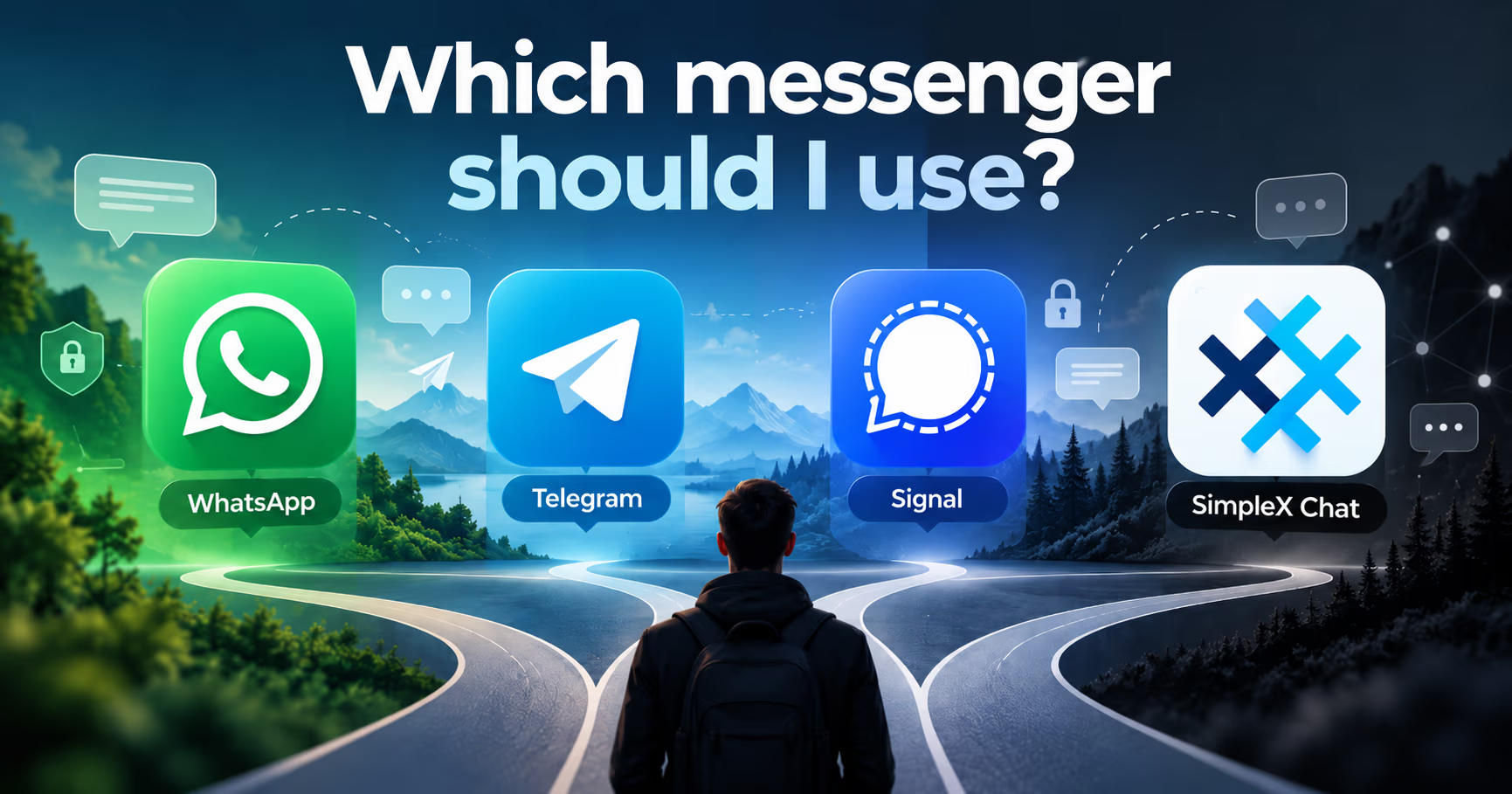
The "which messenger should I use" conversation keeps coming back to the same four apps: WhatsApp, Telegram, Signal and SimpleX Chat. One is on almost every phone on Earth, one has the most features, one is the security benchmark, and one removes identifiers entirely. If you are not a security expert and just want to make the right choice, this post gives you the plain-language answer: what each app protects, what it does not, and when you should pick which.
The short version
- Signal is the most secure messenger for most people. It encrypts everything end to end by default, is open source, is run by a nonprofit, and collects very little metadata. It is also easy enough that you can realistically move a group of family and friends to it.
- WhatsApp is the convenient default. Its messages are encrypted end to end, but Meta collects rich metadata around them, and your account is still tied to your phone number.
- Telegram is the feature machine. Channels, huge groups, bots and cloud sync are hard to beat, but its normal chats are stored on Telegram's servers and are not end to end encrypted; you have to start a Secret Chat manually.
- SimpleX is the most private option on this list. No phone number, no username, no account, not even a random user ID. The trade-off is friction: connections are invitation-based and backups are your job.
- The honest plan: keep WhatsApp for the everyday world, and use Signal for the conversations that matter. If you need maximum anonymity, run SimpleX alongside for that one contact.
What "secure" means before we compare
Two ideas do most of the work, and once you have them, every app below is easy to judge.
Encryption protects the words. End-to-end encryption (E2EE) scrambles a message on your phone so only the recipient's phone can unscramble it. Not even the company running the app can read it. Connection encryption (what Telegram's normal chats use) protects messages while they travel, but the company's servers hold the key and can read what you sent.
Metadata is everything around the words. Who you talk to, when, how often, from where, on which device. Many apps cannot read your messages yet still build a picture of your life from this surrounding data. Privacy is usually decided by metadata, not just by encryption.
At a glance
Telegram | Signal | SimpleX | ||
|---|---|---|---|---|
End-to-end encrypted by default | Yes | No, Secret Chats only | Yes | Yes |
Phone number required | Yes | Yes | Yes | No |
Who can read your messages | No one, but Meta sees your contacts graph | Telegram can, in normal chats | No one, but Signal retains your number and two connection timestamps | No one |
Open source | No (uses the open Signal Protocol) | Client apps only; server is closed | Apps and servers | Apps and servers |
The one-liner | The default | The feature machine | The security benchmark | The anonymous option |
WhatsApp: the one everyone already has
WhatsApp is the world's default messenger, with more than three billion people using it across over 180 countries (company-reported). Since 2016 it has encrypted messages, calls and groups end to end using the Signal protocol, and its own security page stresses that no one can search for your number or read your messages. The content protection is real, with a few edge cases: chats with businesses that use Meta's hosted platform, messages you report, and Meta AI chats sit outside the end-to-end encryption guarantee.
Usernames are also arriving. Reservations opened in late June 2026, and the feature has been rolling out country by country since July; WhatsApp notifies you in the app when your handle goes active. Once it is, new contacts can reach you by username without your phone number being visible to them, and you can turn on an optional username key so people need both your handle and the key to message you. A phone number is still required to register, and usernames do not replace it.
Pros
- End to end encrypted by default, including calls and group chats
- Everyone you know is already on it, which is the hardest part of any messenger switch
- Reliable, simple and free, with opt-in end-to-end encrypted backups
- Works on phones, web and desktop
Cons
- Your account is tied to your phone number, which is still required to register; usernames, now rolling out, do not replace it
- Meta collects rich metadata: who you talk to, when, how often, and device details
- Nothing is open source: the apps and the server are both closed, so you take Meta's privacy promises on trust (the Signal protocol it builds on is open, but the apps are not)
- Default backups to iCloud or Google Drive are not end-to-end encrypted; encrypted backup is opt-in, and most people never turn it on
Telegram: the feature machine that encrypts by choice
Telegram is a cloud messenger with more than a billion users (company-reported) and the biggest feature list in this comparison: channels for unlimited audiences, groups of up to 200,000 people, bots, and chats that sync across every device. That cloud convenience is also its privacy catch.
Pros
- Best-in-class features: channels, huge groups, bots, stickers, polls
- Cloud sync means your history follows you across any device
- Secret Chats do exist, are end to end encrypted, and support self-destructing messages
- Fast, polished, and free
Cons
- Normal chats are cloud chats: Telegram stores them on its servers and can read them, by design
- Secret Chats must be started manually, work only for one-to-one chats, and stay on the device where you started them
- Phone number required, plus an optional @username anyone can search
- Only the client apps' code is published; the server is closed, and Telegram has disclosed data under legal requests in some countries
Signal: the security benchmark you can actually switch to
Signal is the app security researchers recommend first. It encrypts everything end to end by default, publishes its protocol specifications for anyone to audit, and is operated by a 501c3 nonprofit funded by donations rather than ads. Its protocol is so well regarded that WhatsApp itself uses a derivative of it.
Pros
- End to end encrypted by default for messages, calls and groups
- Minimal metadata by design: Signal keeps your number, plus registration and last-connection dates, and little else
- Open source apps and servers, with protocols audited in public
- Usernames let you message people without sharing your phone number
- Disappearing messages built in, plus opt-in encrypted backups: the free tier keeps up to 100MB of message history and the last 45 days of media, and a $1.99 per month tier adds your full history with up to 100GB of media
- Standard registration still requires a phone number, but since September 2026, a one-time $2.99 'Signal Login' option (rolling out from Android beta) removes the number requirement entirely.
Cons
- Much smaller network than WhatsApp or Telegram, so your contacts have to install it
- Fewer features: no big public channels, smaller groups, no bot ecosystem
SimpleX: the most private option, with real friction
SimpleX Chat removes the thing every other messenger keeps: the identifier. No phone number, no username, no account, not even a random user ID behind the scenes. You connect by exchanging one-time invitation links or QR codes, and your profile and history live only on your device. Messages get two layers of end-to-end encryption, forward secrecy, and post-quantum key exchange in direct chats (group chats do not have it yet), delivered through decentralized relay servers.
Pros
- No identifier at all, so there is nothing to look up, link or leak
- End to end encrypted by default, with forward secrecy
- Open source, and you can self-host the relay servers
- Nobody can contact you unless you share a link on purpose, which kills spam
Cons
- You cannot be found, and you cannot find anyone: every connection starts with an invite shared through another channel
- Backups are your job, because there is no server account to restore from
- Much smaller community, so your contacts have to install it and learn the invite flow
- Fewer conveniences: no login-on-any-device cloud sync, and linked devices need explicit setup
For the mechanics of connecting, linking devices, and what "no identifier" really changes in practice, we covered it in depth earlier in SimpleX Chat vs WhatsApp vs Telegram. If you want to run your own relay, we also published a guide to running SimpleX in a small container: SimpleX Chat distroless Docker image with socat.
Signal vs WhatsApp at a glance
The most common real-world question is "should I leave WhatsApp?" Here is the direct comparison:
| Feature | Signal | |
|---|---|---|
| Encryption by default1 | End to end, for every message, call and group | End to end since 2016, using the Signal protocol |
| Phone number | Required to register, hideable with a username | Required to register; usernames are rolling out but do not replace it |
| Who runs it | Signal Foundation, a 501c3 nonprofit funded by donations | Meta, funded by advertising and data |
| Metadata collected | Minimal: number, registration and last-connection dates | Rich: contacts graph, times, frequency, device details |
| Open source | Apps and servers | No; apps and server are closed, built on the open Signal protocol |
| Encrypted backups | Opt-in and end to end encrypted: free tier keeps 100MB of message history and the last 45 days of media; $1.99/month adds full history and up to 100GB of media | Opt-in: default backups to iCloud or Google Drive are not end-to-end encrypted unless you turn that on yourself |
| Best for | Private conversations that matter | Chatting with everyone you know |
Encryption by default1
- Signal
- End to end, for every message, call and group
- End to end since 2016, using the Signal protocol
Phone number
- Signal
- Required to register, hideable with a username
- Required to register; usernames are rolling out but do not replace it
Who runs it
- Signal
- Signal Foundation, a 501c3 nonprofit funded by donations
- Meta, funded by advertising and data
Metadata collected
- Signal
- Minimal: number, registration and last-connection dates
- Rich: contacts graph, times, frequency, device details
Open source
- Signal
- Apps and servers
- No; apps and server are closed, built on the open Signal protocol
Encrypted backups
- Signal
- Opt-in and end to end encrypted: free tier keeps 100MB of message history and the last 45 days of media; $1.99/month adds full history and up to 100GB of media
- Opt-in: default backups to iCloud or Google Drive are not end-to-end encrypted unless you turn that on yourself
Best for
- Signal
- Private conversations that matter
- Chatting with everyone you know
- On WhatsApp, three things sit outside end-to-end encryption: chats with businesses on Meta's hosted platform, messages you report, and Meta AI chats.
Which should you pick?
- Pick Signal if you want the most secure messenger that a normal person can use, and your close contacts are willing to install a second app.
- Pick SimpleX if being untraceable matters more than convenience, for example for sensitive conversations where you do not want any identifier involved.
- Stay on WhatsApp if you need to reach everyone you know, because most of them will never install anything new.
- Pick Telegram if channels, huge groups, bots and cloud sync outweigh your privacy concerns.
- Run both. The realistic setup for most people is WhatsApp for the everyday world and Signal for the conversations that matter. Security is about what you choose to protect, not about declaring a single winner.
Quick answers
Is WhatsApp end to end encrypted? Yes. Messages, calls and group chats are encrypted by default, so Meta cannot read their content. Three things sit outside that protection: chats with businesses that use Meta's hosted platform, messages you report (which go to WhatsApp), and Meta AI chats. And encryption never covers metadata: Meta still sees who you talk to, when and how often.
Is Telegram private? Not by default. Regular chats are stored on Telegram's servers and the company can read them. Secret Chats are end to end encrypted, but you must start them manually and they only work for one-to-one conversations.
Which is the most secure messenger? Signal, for the combination of end to end encryption by default, minimal metadata, open source code and a nonprofit operator. SimpleX offers even more anonymity, with more setup friction in return.
Do I need a phone number? WhatsApp, Telegram and Signal all require one to register. SimpleX does not, which makes it the pick when you want no link between the app and your identity.
Official sources
- WhatsApp security: https://www.whatsapp.com/security
- WhatsApp user numbers and countries: https://www.whatsapp.com/about
- WhatsApp username announcement: https://blog.whatsapp.com/its-time-to-reserve-your-whatsapp-username
- Telegram FAQ (cloud chats and Secret Chats): https://telegram.org/faq
- Signal documentation (protocols and specs): https://signal.org/docs/
- Signal secure backups (tiers and pricing): https://signal.org/blog/introducing-secure-backups/
- SimpleX platform and privacy explanation: https://simplex.chat/docs/simplex.html
- Our SimpleX deep dive: https://systhoughts.com/posts/simplex-chat-vs-whatsapp-vs-telegram
- Our SimpleX self-hosting guide: https://systhoughts.com/posts/simplex-chat-distroless-docker-image-socat
- WhatsApp
current apps - Telegram
current apps - Signal
current apps - SimpleX Chat
current apps
Which app are you moving to, or are you planning to run two? Drop it in the comments.
Until next time, keep your systems thoughtful.
No comments yet