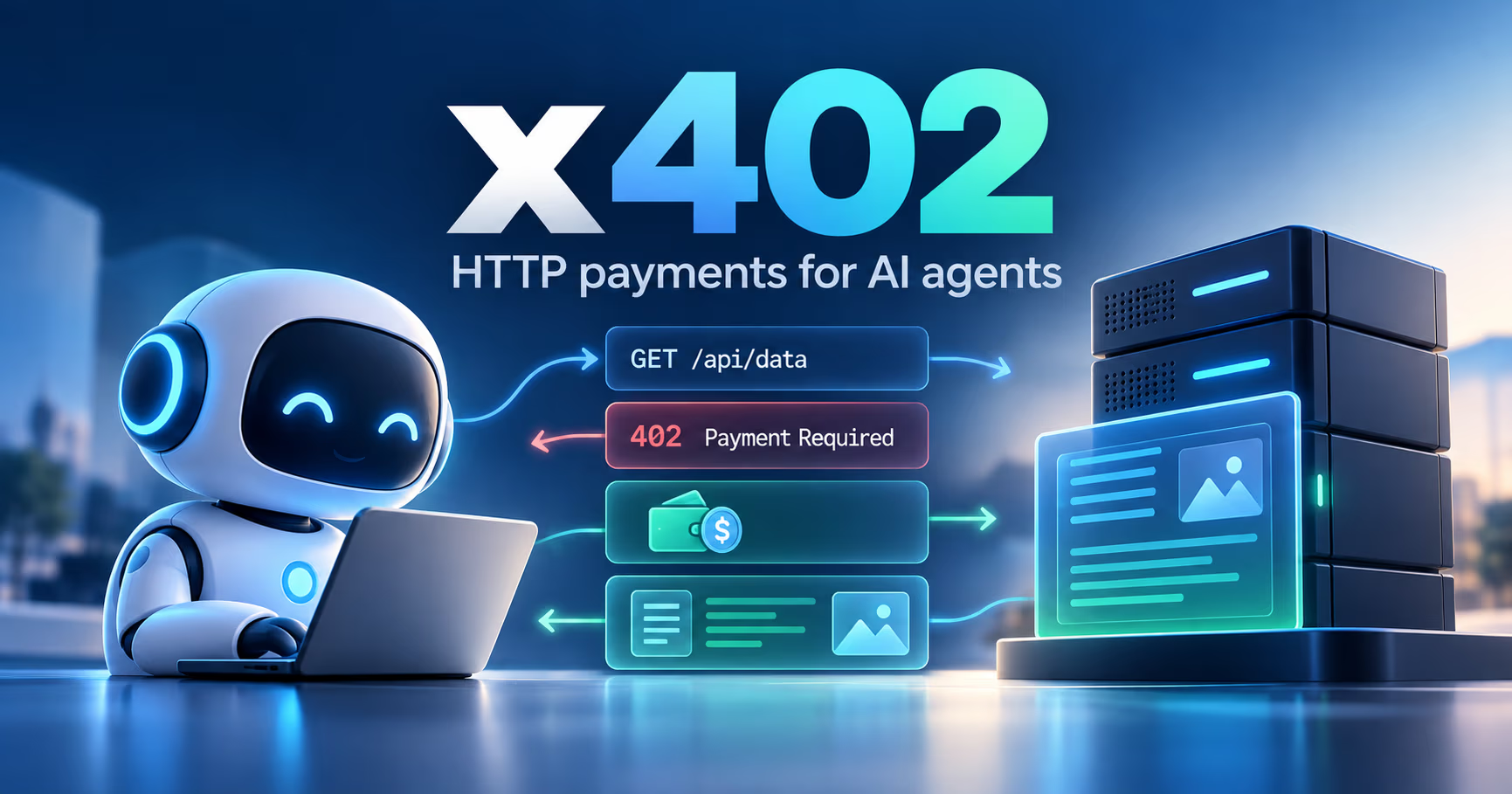
Most of the internet still runs on a quiet assumption: that a human with a browser is the one making every request. That assumption held in 1991 and it has been getting weaker every quarter since. A growing share of the traffic hitting a normal website is a machine: an AI agent summarizing your page, an assistant fetching your API to answer a question, a crawler deciding whether to cite you. And the payment stack never caught up, because cards, accounts, subscriptions, and API keys all assume a human who can fill in a form and wait for approval.
x402, an open payment standard created by Coinbase and now stewarded by the Linux Foundation's x402 Foundation, with 40 member organizations including Cloudflare, Stripe, Visa, Mastercard, Google, and AWS, rebuilds that missing layer: payments as part of HTTP itself. It gives a real job to the long-dormant 402 Payment Required status code.
A client asks for something, the server answers with a price, the client signs a payment, the server returns the resource. No account creation, no checkout flow, no API key to store and rotate. For indie hackers and builders that is a new way to sell APIs, tools, and digital goods. For anyone who has watched agents become a real share of their traffic, it is a revenue layer where today there is only a cost.
The short version
- x402 is payments over plain HTTP. It activates the 402 status code, reserved for "Payment Required" since the original HTTP/1.1 spec in 1997 (RFC 2068, today RFC 9110) and almost never used, so a server can state a price and a client can pay it inside the same request/response pattern.
- The conversation has four moves. Request, 402 with payment requirements, retry with a signed payment payload, response with the resource and settlement details.
- No accounts, no API keys, no checkout. The client's crypto wallet is the credential, which is exactly why an agent can pay without a human in the loop.
- Stablecoins as the settlement rail. Money moves on supported blockchain networks in seconds, and the standard itself charges no protocol fees, only the network's nominal fees.
- Agents are the first-class customer. The protocol is built for machine-to-machine payments: paywalled APIs, MCP tools, and content a summarizing model can buy per fetch.
- It is production-grade and still young. The foundation reports millions of transactions, and the tooling, SDKs, and schemes keep moving.
What x402 actually is
x402 gives a purpose to a status code that HTTP defined decades ago and nobody used. The original HTTP/1.1 spec (RFC 2068, 1997) reserves 402 Payment Required for future use, and for most of the web's life that is exactly what it stayed: a hint about a future that never arrived, because the web's payment rails were built for humans, not for software.
The protocol's move is to treat 402 as a normal part of the conversation instead of an error. When a server is willing to sell a resource, it can answer any request for that resource with a 402 that carries the terms: how much, in which token, on which network, to which wallet. A client that wants the resource can pay from a wallet and retry the exact same request. No signup, no billing dashboard to configure.
Because the standard is open and blockchain-agnostic, it does not care which network or token you use. The documented sweet spot is stablecoin payments (USDC and friends) on any supported chain, EVM, Solana, and more, which keeps the price predictable while settlement still settles in seconds.
The foundation's FAQ reports the standard is production-ready and audited, and the live dashboard on x402.org reported roughly 75 million transactions, about $24 million in volume, more than 94,000 buyers, and 22,000 sellers over the most recent 30 days at the time of writing.
The whole conversation in four steps
The protocol fits on one diagram. Everything else is detail.
   Buyer (agent or app)                      Seller (your server)

 1. GET /api/weather  ------------------------->   check: paid?
        (no payment attached)

 2.  <-------------------------  402 Payment Required
        PAYMENT-REQUIRED (base64): accepted scheme,
        price, network, destination wallet

 3. Wallet signs a payment payload.
    Retry the same request  ------------------->
        PAYMENT-SIGNATURE (base64): the signed
        authorization proving the buyer can pay

 4.  <-------------------------  200 OK + the data
        PAYMENT-RESPONSE (base64): settlement
        details, whether the move succeeded or not
Step one is an ordinary request. The agent or app asks for the resource the way it would ask for anything else.
Step two is the negotiation. The server answers 402 Payment Required and, in the current protocol version, includes a PAYMENT-REQUIRED header holding a Base64-encoded JSON object with everything a buyer needs to pay: accepted payment schemes, price, network, and destination address.
Step three is payload creation. This is where the client becomes a payer. It reads the requirements, asks its wallet to authorize the amount, packages the signed authorization into a payment payload, Base64-encodes it into the PAYMENT-SIGNATURE header, and retries the original request. The server can verify the payload itself or hand it to a facilitator, a service that verifies and settles on the seller's behalf.
Step four is delivery. The server verifies, settles, and returns the resource, plus a PAYMENT-RESPONSE header with the settlement details, whether the payment succeeded or failed. The whole exchange is stateless: two HTTP requests, no session, no customer database.
What is actually in a payload
Conceptually, the payment payload is a signed note from the buyer's wallet that says "you may take this much, to this address, once." It binds the amount, the recipient, the network, and a nonce so a retry cannot double-spend. In the wire format, that payload travels as Base64-encoded JSON, exactly like the requirements did. A simplified sketch, not the full schema, looks like this:
{
  "nonce": "unique-id-per-request",
  "amount": "0.10",
  "token": "USDC",
  "network": "base",
  "recipient": "0x...your-wallet-address",
  "signature": "0x...signed-by-the-buyer-wallet"
}
One caveat before copying the sketch: real V2 messages name the network as a CAIP-2 ID (eip155:84532 for Base testnet), express amounts in atomic units (1000 = 0.001 USDC), and identify the token by contract address, not by symbol. The signature is the whole trick. It is proof of authorization produced by the buyer's wallet, and it is why the server needs no API key, no account, and no customer database to trust the request.
Payment schemes at a glance
The protocol defines a few ways to settle, and the choice changes when money actually moves:
Scheme | How it works | When it fits |
|---|---|---|
Exact | Buyer authorizes exactly the advertised price, settled immediately | Fixed-price API calls and pay-per-fetch content |
Upto | Buyer authorizes a maximum, seller charges actual usage within the same request | Metered APIs where the final price depends on usage |
Batch settlement | Buyers deposit into escrow, pay with off-chain vouchers, value redeemed onchain in batches | High-volume agent traffic where per-request gas would add up |
The batch option is the one to know if you expect agents to hammer your endpoint: it keeps the per-request cost near zero: the buyer funds an onchain escrow once, pays with off-chain vouchers, and the accumulated value is redeemed in batched onchain transactions (EVM and Solana).
The old way vs the x402 way
The whole pitch fits on one side-by-side, the same framing the x402 project itself uses:
| Feature | Traditional API billing | x402 |
|---|---|---|
| Onboarding | Create an account, add a card, wait for approval | Send an HTTP request, pay from a wallet |
| Commitment | Prepaid credits or a subscription you might not use | Pay exactly for what you use, per request |
| Credentials | API keys to generate, store, and rotate | Signed payload per request, no stored secret |
| Settlement | Days-later payouts, chargebacks possible | Stablecoin settlement in seconds, no chargebacks |
| Fees | Processing and payout fees | Zero protocol fees, nominal network fees only |
| Reach | Per-country approval and KYC | Any wallet on any supported network |
Onboarding
- Traditional API billing
- Create an account, add a card, wait for approval
- x402
- Send an HTTP request, pay from a wallet
Commitment
- Traditional API billing
- Prepaid credits or a subscription you might not use
- x402
- Pay exactly for what you use, per request
Credentials
- Traditional API billing
- API keys to generate, store, and rotate
- x402
- Signed payload per request, no stored secret
Settlement
- Traditional API billing
- Days-later payouts, chargebacks possible
- x402
- Stablecoin settlement in seconds, no chargebacks
Fees
- Traditional API billing
- Processing and payout fees
- x402
- Zero protocol fees, nominal network fees only
Reach
- Traditional API billing
- Per-country approval and KYC
- x402
- Any wallet on any supported network
What it unlocks for indie hackers, builders, and entrepreneurs
Strip the crypto vocabulary and the business model is simple: the internet now has a native way to charge per use, and you can put it behind anything you build.
- Per-request API monetization. The middleware is one line of configuration in the seller quickstart, and every call is a sale. You skip Stripe onboarding, dunning emails, and refunds for a tier your customer never used.
- Micropayments that finally make sense. A few cents per fetch adds up at agent scale, and the protocol was designed for exactly that, with batch settlement keeping the onchain cost flat.
- Content paywalls that machines can navigate. A premium report, a dataset, a scraping-friendly API: humans can stay free, and an LLM that wants the answer can pay per fetch instead of bouncing off a login wall it cannot use.
- MCP and agent-tool monetization. The docs include an MCP server with x402, so a paid tool can appear in Claude Desktop and similar clients as a normal tool, with payment handled under the hood. Cloudflare's Agents SDK ships an x402 client for exactly this pattern.
- Discovery for machines. The Bazaar extension is a machine-readable catalog of paywalled endpoints, so agents can find your paid API instead of you fighting for attention in a human search engine.
- Aggregation and reselling. The docs list proxy services that buy and resell API capability, a classic indie wedge: buy access in bulk, resell per request with a margin, collect instantly.
The pattern that matters for a solo builder: you no longer need a billing system to have a paid product. A wallet-to-wallet payment is the product loop.
Why agents change the economics
Here is the shift the user-facing web is only starting to price: more of the traffic that matters is not human. Models read your pages before they answer, assistants fetch your API to verify facts, and crawlers decide whether your site becomes a citation or a mention. Right now most of that machine attention is monetized as a cost: bandwidth, compute, and content scraped for free.
x402 is the counter-move. The same request an agent would make can become a sale if your resource answers with a price instead of a login wall or a free scrape. Three things make this practical for a small team:
- Wallets, not humans. An agent can be given a smart wallet with a spending limit and left to pay per call, exactly like a human with a budget, minus the friction. Coinbase's AgentKit and the Cloudflare Agents SDK already wire this into agent stacks.
- Human free, machine paid. The fair-use pattern is to keep your site readable for people while charging for programmatic access, the API, or the premium fetch. You stop subsidizing everyone who scrapes you.
- Idempotency and receipts as extensions. The payload's nonce stops a signed authorization from being replayed, but duplicate-safe retries are the job of the payment-identifier extension, which lets servers dedupe by payment ID; signed offers and receipts add the cryptographic audit trail agents expect from infrastructure.
For a builder this is the difference between "agents read me for free" and "agents read me and I get paid." If you are already running agents for customers, our Docker sandbox post covers the isolation side, our token reduction post covers the cost side, and our durable workflows post covers the control flow you would bolt a payment layer onto.
The honest caveats
- The buyer side needs a wallet with funds. x402 removes accounts and API keys, not the requirement of holding tokens. Onboarding humans still has friction; onboarding agents does not.
- Stablecoin rails, not card rails (yet). The foundation frames x402 as extensible to traditional payment methods, but the native rail today is stablecoins, with card flows only via gateways wrapping x402. If your market is consumers with credit cards, keep your existing checkout. x402 competes where a machine is the payer.
- The ecosystem is young. SDKs exist for TypeScript, Go, and Python, facilitators are appearing, and the protocol recently moved from V1 to V2, so the details in this post will age. Headers, schemes, and players will keep moving.
- Stats are foundation-reported. The transaction and volume numbers above come from x402.org's own dashboard, not from independent measurement.
- Compliance is your homework. Global stablecoin payments raise tax, licensing, and sanctions questions that no standard answers for you.
- x402 protocol
V2 (PAYMENT-REQUIRED, PAYMENT-SIGNATURE, PAYMENT-RESPONSE) - Docs
docs.x402.org - Schemes
exact, upto, batch-settlement
Flow, headers, and schemes verified against docs.x402.org on 2026-09-27. Ecosystem stats are x402.org dashboard figures, foundation-reported. The protocol and tooling move fast; reconfirm before you pin anything.
Should you build on it?
- Start now when you sell an API, a dataset, an MCP tool, or pay-per-fetch content and your buyers are developers or agents, who will happily trade an account for a wallet.
- Test it when you already have a human checkout and you want a programmatic channel: protect the API, keep the human path, and measure whether machine demand appears.
- Hold off when your product is consumer checkout, your customers do not hold wallets, or you need regulated card rails and invoicing.
- Keep the architecture honest. The payment standard settles a price; your job is the product loop around it: pricing, limits, and the workflow the payment unlocks.
Official sources
- x402 home: https://x402.org/
- x402 documentation: https://docs.x402.org/
- Core concepts, HTTP 402: https://docs.x402.org/core-concepts/http-402
- Client/Server roles and flow: https://docs.x402.org/core-concepts/client-server
- Payment schemes: https://docs.x402.org/schemes/overview
- MCP server with x402: https://docs.x402.org/guides/mcp-server-with-x402
- Coinbase introduction: https://www.coinbase.com/developer-platform/discover/launches/x402
- Cloudflare announcement: https://blog.cloudflare.com/x402/
What would you paywall first: your API, your newsletter, or your data? And would you keep the human path free while agents pay? Drop it in the comments.
Until next time, keep your systems thoughtful.
No comments yet