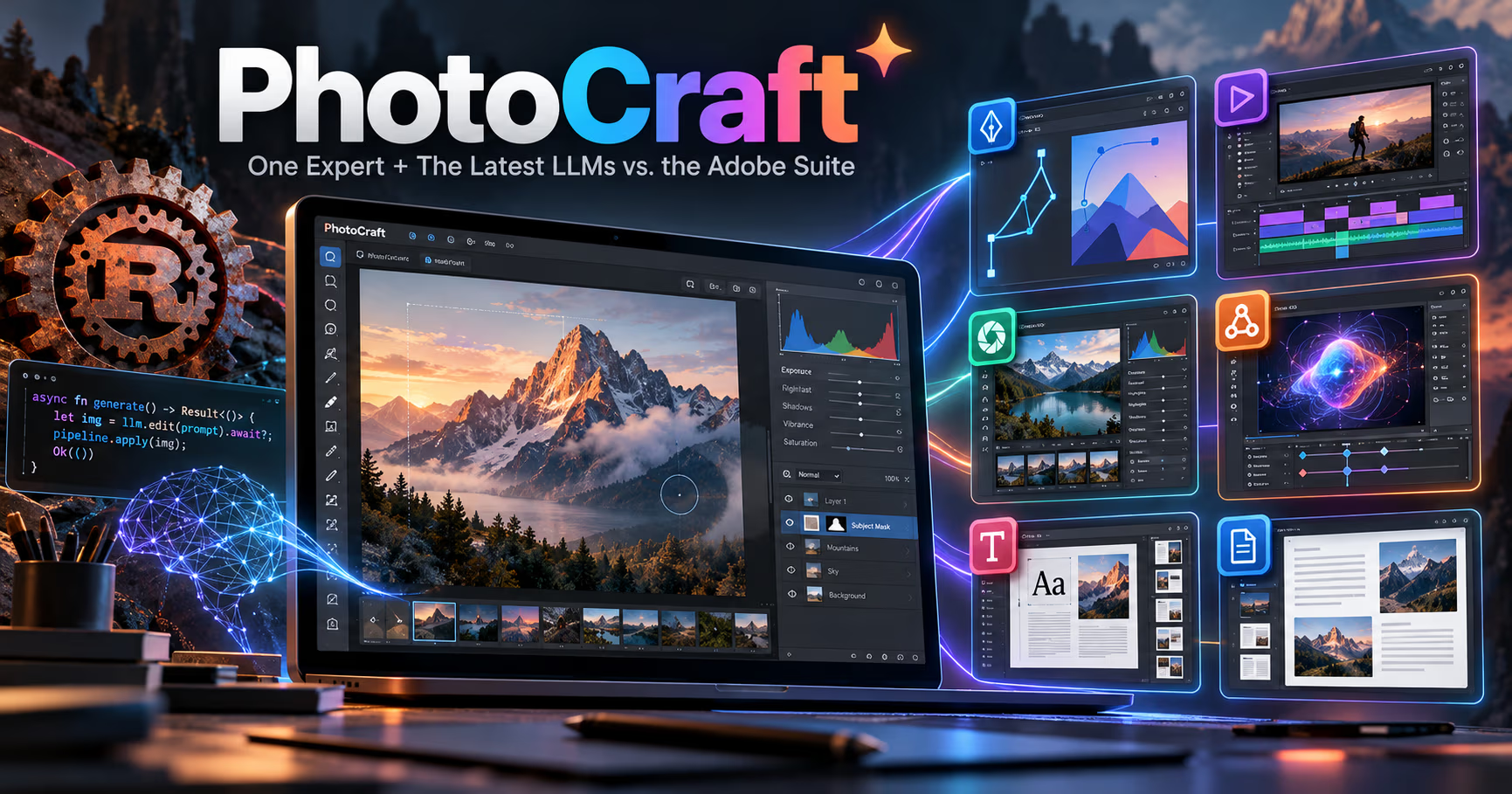
A Rust developer open sourced a suite of apps that mirror Photoshop, Illustrator, Premiere, Lightroom, After Effects, InDesign and Acrobat Pro, written from scratch in pure Rust.
He used an AI coding agent at full force, shipped seven apps at once, and pushed the whole suite to GitHub for anyone to inspect, fork or fix. Creative software may not be the same after this.
The project is called ArtCraft. The first app out of the gate is PhotoCraft, an open source Photoshop-style image editor, and it is the most complete piece of the suite today.
In the announcement, the author says he used Claude Opus 5.5 to build clean-room replacements for seven Adobe applications, with no Electron wrapper anywhere: everything compiles to native apps for macOS, Windows and Linux, and most of the apps also run in the browser as WebAssembly.
The apps are free, the source code is under MIT and Apache licenses, and the projects are funded by the team's existing AI image and video tools rather than by subscriptions for the editors themselves.
The announcement: seven apps, one repo tree
Brandon Thomas, a developer with roughly a decade of large-scale Rust work, posted the announcement in early October 2026 across Reddit's SaaS, Adobe and GeminiAI communities, and the story spread to Hacker News, Ars Technica, Tom's Hardware, Gizmodo and Phoronix within days.
The ArtCraft team previously shipped a visual AI studio for controlled image and video generation. The seven-app suite is the pivot from that studio to a full lineup of Creative Cloud alternatives, and the pace is part of the story: the repos went public as a family, not as one app trickling out.
The list he is recreating maps one to one to the Adobe stack:
- PhotoCraft replaces Photoshop: layers, masks, adjustment layers, smart objects, type, vectors, a real brush engine.
- VectorCraft replaces Illustrator: resolution-independent vector drawing for illustration and logo work.
- FilmCraft replaces Premiere Pro: a multi-track video editor with scopes and a timeline.
- LightCraft replaces Lightroom: a non-destructive raw developer and photo library.
- EffectCraft replaces After Effects: motion graphics and visual effects compositing.
- DesignCraft replaces InDesign: page layout and publishing.
- PrintCraft replaces Acrobat Pro: a PDF workbench that reads, organizes, combines, splits and secures documents.
The site lists twelve apps in total, so word processing, audio, presentations, CAD and spreadsheets are also on the roadmap.
The LLM capability question
What does this announcement say about the state of large language models in 2026?
First, the raw ability to write the code is now table stakes.
The current wave of models can hold the architecture of a large native application in context, keep interfaces consistent across dozens of crates, and type-check its way through a language as unforgiving as Rust while following a structured implementation plan.
When the compiler rejects a line, the agent reads the error and retries until it passes, and PhotoCraft is evidence that this loop, run by an expert operator, can go much further than most people assumed.
Second, the scarce skill has moved up the stack. Recreating Photoshop in Rust is not a prompting problem. You need someone who can design the plan, decompose months of work into phases, write the eval harness, judge the quality of each output, and decide what to throw away. The author is exactly that person: a Rust expert who knows what the original app should feel like and can catch the model when it drifts. The agent accelerates this person. It does not replace them.
Third, and this is the part I keep coming back to: the agent absorbed the bulk of the implementation work, and the human author supplied the taste. Typography that matches the original app, the right keyboard shortcut in the right place, a histogram panel that reads instantly as professional, these are judgment calls that no generic autocomplete produces. An expert with strong opinions about craft, delegating to a tireless adapter, is a different kind of builder than either the solo engineer of 2020 or the vibe coder of 2024.
Momentum and reality check
At the time of writing, the PhotoCraft repo has passed around 50,000 GitHub stars, and LightCraft sits around 10,600. Those numbers are unusual for brand-new repos with no marketing budget, and they confirm real audience hunger for local, subscription-free creative tools.
But the gap between star count and daily-driver status is real, and the author being upfront about it. The apps are early alpha. Graphics and video tools live and die on stability, file fidelity with decade-old PSD and Premiere projects, and a plugin ecosystem, and those take time and community contributions that a one-person launch cannot manufacture overnight. The seven-app-at-once pace is a headline, not the whole story.
My honest overall sense: this project would have been impossible eighteen months ago, and that includes the expert steering it. Today it exists, and tomorrow it gets easier. The code-writing bottleneck is collapsing, the remaining friction is architecture, fidelity and taste, and that is why an expert developer with domain depth is suddenly the best possible pilot for this kind of build. Professionals can already download PhotoCraft and LightCraft today, so the practical takeaway is to try them on real work and file honest bug reports.
Where this lands
The categories on that twelve-app list are about to get crowded, and the projects that win will not be the ones with the best launch story, they will be the ones with the best maintenance story. Anyone building software in one of those categories should take that seriously starting today.
What we watch from here: whether the model quality and community governance let the suite graduate from early alpha to production, or whether it plateaus the way most solo AI projects do. The remaining friction is architecture, file fidelity and taste, and those are exactly the dimensions where expert developers matter most.
Sources and further reading
- Announcement on r/SaaS
- r/Adobe crosspost
- r/GeminiAI thread
- Hacker News discussion
- Ars Technica: software is over
- Tom's Hardware: solo developer rebuilds Adobe Creative Suite
- Gizmodo: someone vibe coded a free knockoff of Adobe Creative Suite
- Phoronix: open source clean room implementations
- PhotoCraft on GitHub
- LightCraft on GitHub
- ArtCraft apps
What would you rebuild first with an expert agent and a model like this? Tell me what you think in the comments, or take one of these tools for a spin yourself.
No comments yet