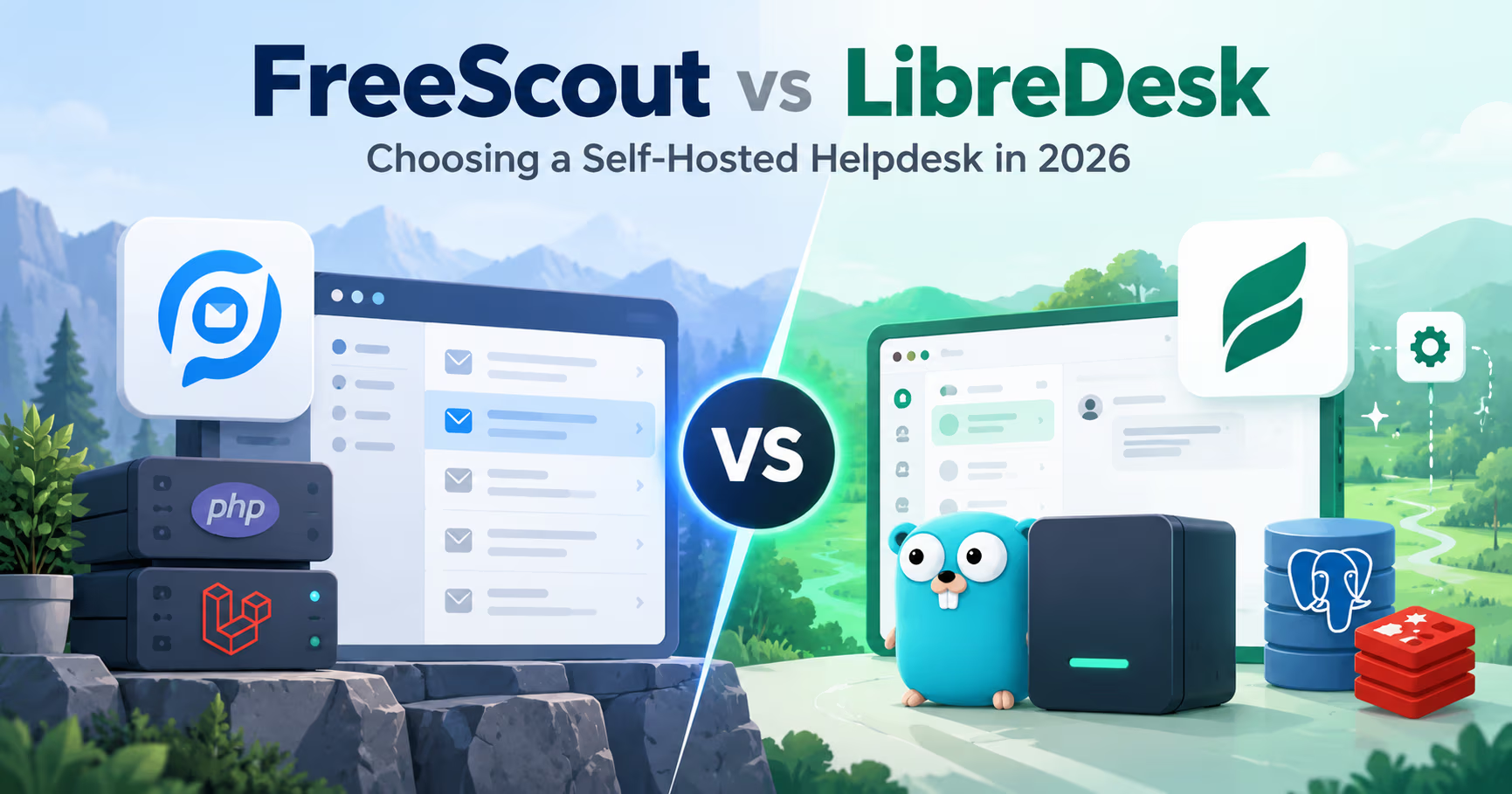
Two free and open source helpdesks dominate the self-hosted conversation in 2026, and they make an odd pair. FreeScout is the PHP veteran: a Help Scout style shared inbox built with the Laravel framework, mature enough to run on shared hosting, with a catalog of paid add-on modules for everything beyond the core. LibreDesk is the newcomer: a single Go binary backed by PostgreSQL and Redis that ships SSO, custom attributes, macros, an API, and a help center in its free core.
If you run one and keep hearing about the other, the question is not which helpdesk is better; it is which trade you want to own.
If you remember one sentence, make it this one: FreeScout is the mature pick that charges one-time fees for the features your agents touch daily; LibreDesk is the lighter pick that includes those features and asks you to trust younger software.
The short version
- Same license, opposite bundles. Both are AGPL-3.0 open source. FreeScout's core is free with unlimited agents and mailboxes, and the day-to-day features (saved replies, custom fields, the API, SAML login) are paid one-time modules. LibreDesk includes all of them, with no paid tiers.
- The stack is the real divide. FreeScout is PHP (Laravel) on MySQL or MariaDB behind nginx or Apache, with a minute-level cron job driving mail fetching and queue workers. LibreDesk is one Go binary plus PostgreSQL and Redis, with mail fetching and background jobs in-process.
- Deployment: community versus official containers. FreeScout has no first-party Docker image; you use a community image or classic hosting. LibreDesk ships an official compose file, an official image, and native binaries.
- SSO: modules versus built-in. FreeScout's SAML SSO is a $10 module; OAuth and LDAP are separate modules. LibreDesk signs in through Google, Microsoft, or any OIDC provider out of the box (no SAML yet).
- Migration is a rebuild, not a copy. No direct importer exists between them. Reconnecting mailboxes is easy; conversation history is the part most teams should freeze and archive instead of migrating.
The stack is the story
FreeScout calls itself super lightweight, and in the sense its docs mean, it is: a pure PHP/MySQL application with no minimum CPU or RAM requirement, easy to run on shared hosting. The operational reality is still a classic PHP constellation: a web server (nginx, Apache, or IIS), PHP 7.4 through 8.x, MySQL or MariaDB (PostgreSQL is listed as supported), and a cron entry that runs every minute and drives mail fetching, monitoring, and queue workers. The Docker route is a community-maintained image that bundles the whole constellation for you.
LibreDesk sits at the other end of the design space: the backend is Go, the frontend is Vue 3, and the app ships as a single binary that talks to PostgreSQL and Redis. The web server (it listens on port 9000 by default), mail fetching, and background jobs all live inside that one process. Deployment is an official docker-compose.yml and Docker Hub image, or a bare binary for Linux, macOS, Windows, and the BSDs.
Neither project publishes resource baselines and I have not benchmarked either, so treat the weight comparison as structural, not measured: LibreDesk hands you fewer processes to patch, monitor, and back up, while FreeScout gives you more places to tune and a much lower floor in hosting restrictions. That last point is the honest case for FreeScout's stack: on a restricted host, PHP and MySQL win because they are all you are allowed to have.
The five questions that decide the move
Single sign-on
FreeScout ships no SSO in the core. SAML 2.0 for admins and agents comes from the SAML SSO module ($10, one-time, with FreeScout acting as the service provider); Google or Azure agent logins come from the OAuth & Social Login module, and directory logins from the LDAP module. All are open source under AGPL-3.0 but unlocked by a paid per-instance license. LibreDesk treats SSO as table stakes: Google, Microsoft, or any OIDC provider works out of the box, with per-action role permissions in the same core. If your identity provider speaks only SAML, neither story is perfect: FreeScout wants the paid module, and LibreDesk has no SAML support at the time of writing.
Custom attributes
In FreeScout, extra data lives in the paid Custom Fields module, which adds fields to conversations; customer-level fields need the Customers Management (CRM) module, and custom field values double as variables inside saved replies. LibreDesk builds custom attributes into the core for both contacts and conversations (a subscription plan, the date of a first purchase). For a migration, the mapping is usually mechanical, but FreeScout's module-specific field types deserve a mapping spreadsheet before you promise anything.
Saved replies and macros
FreeScout's canned responses are a paid module: Saved Replies ($4.99) inserts text snippets into the editor, with custom-field variables for personalization; bundling actions like tagging and assigning means the separate Workflows module. LibreDesk's macros go further in the free core: one macro sends the message, sets tags, and assigns the conversation to a team in a single step. If your agents live in canned responses with actions attached, this is where LibreDesk's bundle removes the most friction.
API and webhooks
FreeScout's REST API and webhooks exist behind the paid API & Webhooks module: a global key plus personal per-user keys, conversation and customer events, and signed webhook deliveries with retries. It is a capable API; the catch for this specific topic is that most FreeScout export and migration tooling, including third-party migration services, requires that module to be installed first. LibreDesk ships HTTP/JSON APIs and webhooks in the core, so integrations and migration scripts cost nothing up front.
Docker and deployment
FreeScout's first-class target is a PHP-capable web host, and its README says so: shared hosting, one-click installers such as Softaculous and Cloudron, and a community Docker image. On a bare VM you assemble the web server, PHP, and cron yourself. LibreDesk's repository carries the official compose file (app plus PostgreSQL plus Redis) and the official libredesk/libredesk image, with Railway as a one-click option. If your 2026 baseline is compose files behind a reverse proxy, LibreDesk's path looks like everything else you already run.
| Feature | FreeScout | LibreDesk |
|---|---|---|
| Language and framework | PHP with the Laravel framework | Go backend, Vue 3 frontend |
| Database | MySQL or MariaDB (PostgreSQL also supported) | PostgreSQL, with Redis required |
| Other runtime pieces | Web server, PHP runtime, minute-level cron for mail fetching and queue workers | Single binary handles the web server, mail fetching, and background jobs |
| Deployment | Shared hosting, one-click installers, community Docker image | Official compose file and Docker Hub image, native binaries, Railway 1-click |
| SSO1 | Paid modules: SAML SSO ($10), OAuth login, LDAP | Built-in: Google, Microsoft, any OIDC provider |
| Custom attributes | Paid Custom Fields module; customer fields need the CRM module | Built-in for contacts and conversations |
| Saved replies and macros | Paid Saved Replies module (text snippets with variables) | Built-in macros: send message, set tags, assign to a team in one step |
| API and webhooks | Paid API & Webhooks module (global and personal keys) | Built-in HTTP/JSON API and webhooks |
| Help center | Paid Knowledge Base module | Built-in, multilingual |
| Automations | Paid Workflows module | Built-in rules engine |
| CSAT and analytics | Paid Satisfaction Ratings module | Built-in CSAT and analytics |
| Channels | Email in core; WhatsApp, Telegram, Facebook, live chat as paid modules | Email, live chat widget, and WhatsApp (Meta Cloud API) in core |
| License and price2 | AGPL-3.0 core plus paid lifetime module licenses per instance | AGPL-3.0, every feature included, no paid tiers |
| Maturity3 | Years in production, about 4.6k GitHub stars, 33 languages | Young project, v2.8.0 in August 2026, about 3.1k stars |
Language and framework
- FreeScout
- PHP with the Laravel framework
- LibreDesk
- Go backend, Vue 3 frontend
Database
- FreeScout
- MySQL or MariaDB (PostgreSQL also supported)
- LibreDesk
- PostgreSQL, with Redis required
Other runtime pieces
- FreeScout
- Web server, PHP runtime, minute-level cron for mail fetching and queue workers
- LibreDesk
- Single binary handles the web server, mail fetching, and background jobs
Deployment
- FreeScout
- Shared hosting, one-click installers, community Docker image
- LibreDesk
- Official compose file and Docker Hub image, native binaries, Railway 1-click
SSO1
- FreeScout
- Paid modules: SAML SSO ($10), OAuth login, LDAP
- LibreDesk
- Built-in: Google, Microsoft, any OIDC provider
Custom attributes
- FreeScout
- Paid Custom Fields module; customer fields need the CRM module
- LibreDesk
- Built-in for contacts and conversations
Saved replies and macros
- FreeScout
- Paid Saved Replies module (text snippets with variables)
- LibreDesk
- Built-in macros: send message, set tags, assign to a team in one step
API and webhooks
- FreeScout
- Paid API & Webhooks module (global and personal keys)
- LibreDesk
- Built-in HTTP/JSON API and webhooks
Help center
- FreeScout
- Paid Knowledge Base module
- LibreDesk
- Built-in, multilingual
Automations
- FreeScout
- Paid Workflows module
- LibreDesk
- Built-in rules engine
CSAT and analytics
- FreeScout
- Paid Satisfaction Ratings module
- LibreDesk
- Built-in CSAT and analytics
Channels
- FreeScout
- Email in core; WhatsApp, Telegram, Facebook, live chat as paid modules
- LibreDesk
- Email, live chat widget, and WhatsApp (Meta Cloud API) in core
License and price2
- FreeScout
- AGPL-3.0 core plus paid lifetime module licenses per instance
- LibreDesk
- AGPL-3.0, every feature included, no paid tiers
Maturity3
- FreeScout
- Years in production, about 4.6k GitHub stars, 33 languages
- LibreDesk
- Young project, v2.8.0 in August 2026, about 3.1k stars
- LibreDesk has no SAML at the time of writing
- FreeScout module licenses are one-time
- Stars as of this writing
Migration in 2026: what actually moves
The mailbox is the easy part. Both products fetch mail over IMAP and send over SMTP, so a cutover is: pause FreeScout's cron, point LibreDesk at the same mailboxes, send yourself a test thread, and watch it land. DNS and MX records never change, and if the new desk misbehaves you repoint the same credentials at FreeScout and you are back. The deeper mail pitfalls are the same as any self-hosted email move, which our self-hosting email in 2026 piece covers.
Conversation history is the hard part, and there is no FreeScout-to-LibreDesk importer to paper over it. Getting data out of FreeScout means its paid API & Webhooks module (or the Export Conversations CSV module); loading it into LibreDesk means your own scripts against its API. The pragmatic pattern most sysadmins land on: freeze the old FreeScout instance as a read-only archive, start fresh in LibreDesk, and migrate only forward-looking data such as customers if you truly need it. Pushing years of threads through two APIs is rarely worth it next to keeping the archive around.
Everything else is a rebuild, and it is mostly small: saved replies become macros, custom fields become custom attributes, module settings become core settings, and agents relearn one new screen. Budget a day for the rebuild, not the migration plumbing.
Choose FreeScout when
- Your host is restrictive. A pure PHP/MySQL app that runs on shared hosting is still a superpower when you cannot add PostgreSQL and Redis.
- You need the long tail of channels and integrations today. Telegram, Facebook, Slack, Jira, WooCommerce, SMS: FreeScout's module catalog covers ground LibreDesk has not reached.
- Maturity matters more than the bundle. Years of production reports, a large community, 33 translations, and conservative, predictable releases.
- Your team hates UI churn. FreeScout's inbox has been stable for years; LibreDesk is shipping fast and will keep changing under you.
Choose LibreDesk when
- You want the good parts in the free core. SSO, custom attributes, macros, API, help center, SLA tools, CSAT: no license keys to track.
- You run compose-first infrastructure. An official image and compose file, plus PostgreSQL and Redis you probably already operate.
- You want fewer moving pieces. One binary process to patch, monitor, and restart instead of a PHP constellation with cron.
- You accept young software with open eyes. Smaller ecosystem, faster churn, and a roadmap worth reading before you bet the support desk on it.
When neither is the right answer
- Your identity provider speaks SAML only. FreeScout needs the paid module and LibreDesk has no SAML today; either way you are bolting something on.
- You want a hosted vendor. Neither offers one: LibreDesk explicitly ships no hosted version, and FreeScout is self-hosted or a managed partner.
- Your workflows depend on FreeScout's niche modules. Checklists, wallboards, Kanban, WooCommerce: verify each has a real LibreDesk equivalent before you commit, because several do not.
The honest limits
- No benchmarks in this post. Neither project publishes RAM or CPU baselines and I measured none; the weight comparison is structural (how many processes and services you own), not measured.
- LibreDesk is young. Version 2.8.0 shipped in August 2026, so the production track record is short; check the changelog and open issues before committing a support desk to it.
- Prices and features are a snapshot. FreeScout module prices here come from the official module pages, checked in October 2026; both projects move fast, so verify against current docs.
- FreeScout
docs verified 2026-10-21 - LibreDesk
v2.8.0, released 2026-08-22
FAQ
Does LibreDesk support SAML?
Not at the time of writing. LibreDesk's built-in SSO is OIDC only: Google, Microsoft, or any OIDC-compliant provider. If your organization is SAML-only, the current options are FreeScout with its paid SAML SSO module, or an OIDC bridge in front of your identity provider. Check the LibreDesk roadmap, because identity options are a common feature request for self-hosted tools.
Can FreeScout really run on shared hosting?
Yes, and that is its structural advantage: a pure PHP/MySQL application with no minimum CPU or RAM requirement, needing only a web server, PHP, a database, and a cron entry. LibreDesk cannot follow you there, because it requires PostgreSQL and Redis and ships as a binary or container instead of a PHP application your host already knows how to serve.
Is there a direct FreeScout-to-LibreDesk migration tool?
No. Data leaves FreeScout through its paid API & Webhooks module or the Export Conversations CSV module, and it enters LibreDesk through that project's own API, so history migration is a script-it-yourself job. Most teams freeze the old instance as a read-only archive rather than pushing years of conversations through two APIs.
Is LibreDesk really free where FreeScout charges?
For the features compared here, yes: SSO, custom attributes, macros, the API, the help center, and CSAT all sit in LibreDesk's free AGPL-3.0 core with no paid tiers. FreeScout's core is also free with unlimited agents, but each of those features is a paid one-time module. Both codebases are open source under AGPL-3.0.
Which should a small team pick in 2026?
If you already run FreeScout happily, there is no urgency: it is stable, mature, and cheap unless your module cart keeps growing. If you are starting fresh on compose-based infrastructure, or the module paywall is what pushed you to look, LibreDesk is the lighter and more complete free core, provided you accept a younger codebase.
Further reading
- FreeScout project site and full module catalog: https://freescout.net/ and https://freescout.net/modules/
- FreeScout on GitHub, requirements and license: https://github.com/freescout-help-desk/freescout
- FreeScout installation guide, including the cron setup: https://github.com/freescout-help-desk/freescout/wiki/Installation-Guide
- LibreDesk project site: https://libredesk.io/
- LibreDesk on GitHub: https://github.com/abhinavxd/libredesk
If you have made this exact move, from FreeScout to LibreDesk or the other way, tell me what broke and what you would do differently. Drop it in the comments.
Until next time, keep your systems thoughtful.
No comments yet